
500+ Nature & Animal Trivia Questions
Free questions with answers for kids and grown-ups, from the makers of the Triviavore board game. Tap a question to reveal the answer.
Play them as a game →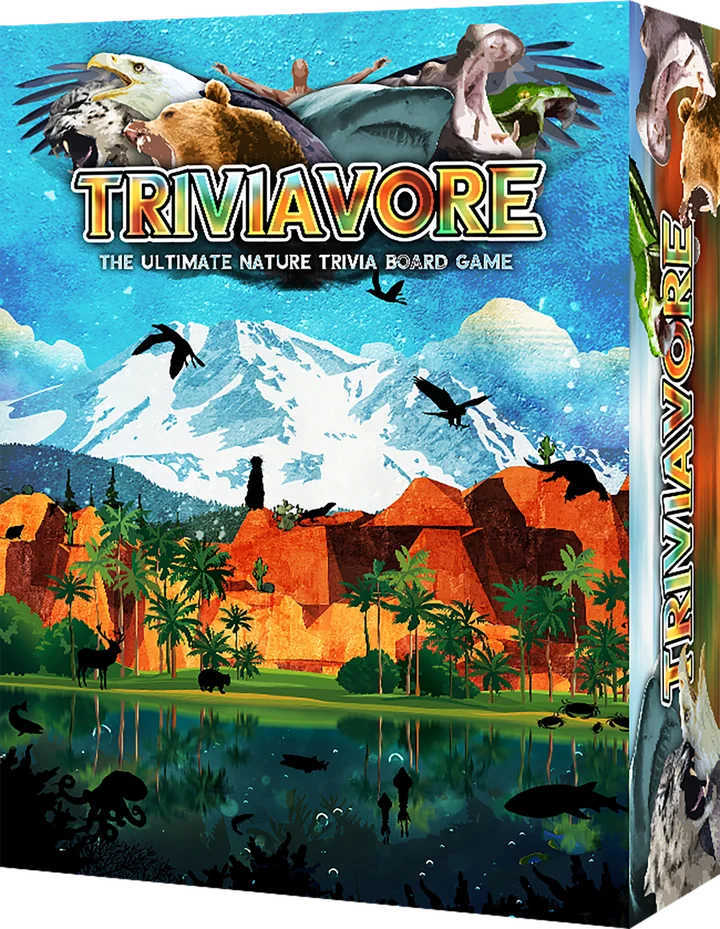
Want 150+ more, plus a board?
Triviavore turns trivia into a food-chain battle for 2–4 players. None of these questions are in the box.
Easier animal trivia for kids (54)
Did any mammals in history fly, yes or no?
Yes; bats are mammals and they fly.
Which has stronger hearing, rabbits or snakes?
Rabbits have strong hearing and big ears. Snakes don't have ears.
How many hearts does an octopus have: 1, 2, or 3?
An octopus has 3 hearts.
Do mammals and birds tend to be bigger where the weather is colder?
Yes! Animals don't need to be big to be warm, but it may help.
Which appeared on earth first, insects or dinosaurs?
Insects were here even before dinosaurs.
Do house kittens have eyes that change colors when they grow up?
Yes. They start with blue eyes but could later have different colors, in each eye!
Which beats quicker, the heart of a hummingbird or the heart of a whale?
The hummingbird heart beats the fastest of any animal besides insects.
When it is born, can a rattlesnake make a rattle noise?
No, its small rattle when it is born is called a button, and it doesn't rattle yet.
Which came first, the cactus or the dinosaur?
Dinosaurs came first. Cactus plans came later.
At birth, is a polar bear cub smaller than a human baby or bigger?
A polar bear cub is usually much smaller, but then it grows very big.
Is there any desert that is so dry that nothing lives there?
Yes. One desert in Chile is too dry for animals, plants, and even bacteria, which all need water.
How many eyes can a scorpion have: 6 or 12?
Scorpions can have as many as 12 eyes.
Did the largest shark that ever lived mostly eat fish or whales?
The largest shark, a megaladon, ate whales.
Are mushrooms (1) plants, (2) animals, or (3) something else?
(3) They are fungi, not plants or animals.
Who blinks more, baby humans or adults?
Babies only blink once or twice a minute. Adults have drier eyes and blink more.
Can a butterfly (1) hear with its wings or (2) smell with its wings?
(1) A butterfly has organs on its wings that help it to hear.
Does a sea star have a brain?
No, a sea star has no real central part of its nervous system.
Does a spider's web come from its mouth?
No, the center of a spider is the abdomen. The abdomen has an organ which spins the web.
Which is a faster runner, a dog or an ostrich?
An ostrich can run even faster than a dog.
Which is born with horns, a rino or a giraffe?
A giraffe is born with small horns on its head. The rino grows horns after it is born.
Which came first, turtles or pigs?
Turtles lived before dinosaurs, and well before mammals like pigs.
Which has more bones, a human baby or a human adult?
A human baby has more bones. Some fuse together as the baby grows older.
Do some trees lose their leaves in the fall because days get shorter, or because days get colder?
Some trees lose their leaves when the days get shorter, even if it's not cold.
Do sunflowers turn and follow the sun or just look like the sun?
They turn with the sun to catch more sunshine and grow seeds.
Do rabbits mostly eat carrots or grasses?
Rabbits mostly eat grasses. Carrots are a treat they rarely eat in the wild.
Is an owl better at seeing food or smelling food?
An owl has keen, big eyes to hunt food. Owls may not smell anything, so some like to eat skunks.
Which has more toes, a chicken or a horse?
A chicken usually has four toes on each foot. A horse only has one toe, a hoof, on each foot.
What do deer do with skunk cabbage, hide their scent or eat it?
Deer like to eat skunk cabbage, even though it smells funny.
How many tiny organisms can live in one spoon of dirt: (1) thousands, or (2) hundreds of millions?
(2) Hundreds of millions of tiny organisms, most too small to see, can live in a spoonful of soil.
In the deep sea, can most sea animals glow in the dark?
Yes, perhaps three quarters of deep sea animals can glow in the dark.
Do most antelope (1) shed their horns, or (2) keep their horns year-round?
(2) Most antelope keep and grow their horns year-round. Deer shed their horns in winter.
Does a mushroom use the ridges in its cap for breathing or to release spores?
The ridges in the cap store and release spores to produce more mushrooms.
Which can grow heavier, a grizzly bear or an American buffalo?
The American buffalo is much heavier than a grizzly bear. But grizzlies grow much bigger than humans.
Do any mature insects live underwater?
No. But some have larva that live underwater, and some swim on the surface of water.
Does a tulip reproduce from its root bulb, from its flower, or both?
Both. Its bulb can be split to form clones, and it also has fertile flowers.
Do pineapples come from pine trees?
No. They are named pineapples because the fruit looks like a pine cone.
Which animal ejects its own tail to distract predators, (1) a mink, (2) a skink, or (3) a skunk?
(2) A skink, a type of lizard, can detatch its tail to distract predators and run away.
Which has a pouch for babies, a male kangaroo or a male sea horse?
A male sea horse stores eggs from a female sea horse in a stomach pouch. Only the female kangaroo has a pouch.
An elephant has one of the largest poops in nature. Does it poop about once a day or about 20 times a day?
About 20 times a day. It eats a lot but digests less than half of his food.
Is a sea horse a fish or a crab?
A sea horse is a fish, with an internal spine, gills, and fins.
Can earthworms sense light without eyes?
Yes. Earthwoms have no eyes, but they do have cells that sense light.
When dinosaurs lived, were trees taller than the tallest trees today?
No. The tallest trees ever are today's redwoods. But ferns from their time were bigger than now.
Does a seastar usually have two jaws or five?
A seastar usually has five jaws.
How many eyes does a scallop have: (1) no eyes, or (2) dozens of eyes?
(2) A scallop has dozens of eyes.
Many sponges are shaped like pipes, with a hole at the top. Is that hole for breathing or pooping?
The hole at the top is for pooping -- ejecting food waste.
Do the tusks of a male elephant stop growing when it is an adult, or do they keep growing?
They keep growing throughout the elephant's life.
Does a carrot grow downward because it senses soil thickness or gravity?
It senses gravity, helping roots to grow downward and shoots to grow upward.
Does a sea turtle have gills or lungs?
Sea turtles have lungs and have to find the surface to breathe.
Which can break the glass of an aquarium, a boxer crab or a mantis shrimp?
Smasher claws of some mantis shrimp can move quickly and break thick glass. Boxer crabs are slower.
Can dragon flies live in the arctic and high mountains, or just where it's warmer?
Dragonflies might fly thousands of miles and live in the cold and in tall mountains.
How many muscles are there in an elephant's trunk, about 400 or about 40,000?
There are about 40,000. Parts that can twist in many directions may have the most muscle groups.
Can baby freshwater crocodiles cry inside their eggshells?
Yes. Freshwater crocodiles cry out from their eggshells to be carried to water by an adult.
Do humans have tail bones?
Yes, humans have three to five tail bones, but they don't stick out. So unlike monkeys, we have no tail.
Which has more legs, a crab or an insect?
A crab is a "decapod" because it has ten legs. Insects have six legs.
Nature & animal trivia for older kids and adults (492)
How many years ago was the first living thing on earth born: about 4 billion or about 40 billion years ago?
The earth is between 4 and 5 billion years old, and the first living (bacteria-like) organisms appeared about 4 billion years ago, perhaps in hot ocean vents.
When Portuguese man of war colonies partially fuse one jellyfish to another, what do they share: brains or guts?
They fuse their amorphous guts and don't have centralized brains.
How much water can a saguaro (cactus) absorb and store in a rainstorm: (1) only about 70 liters (18 gallons), or (2) as much as 700 liters (180 gallons)?
Over 700 liters. (Over 180 gallons.)
Which appeared on earth the earliest, the dinosaur, the cockroach, or the jellyfish?
Fossils suggest soft tissue invertebrates like jellyfish and flatworms appeared long before dinosaurs and arthropods like cockroaches.
Which type of mammal is most likely to see a large drop in body temperature during hibernation: a bear or a rodent?
Rodents (squirrels, marmots, hamsters) have a large drop in body temperature during hibernation. Bears don't.
Which doesn't build a nest, an albatross, an eagle, or an owl?
An owl takes over old nests from other birds or uses holes in trees; it does not build nests.
Choose the creature that can shrink its own brain: (1) An oyster squeezing into a shell. (2) An Indian jumping ant diverting energy for reproduction.
(2) A jumping ant may shrink its brain to develop queen reproductive parts. An oyster has no central nervous system or brain.
Which creature has trinocular vision (three eyes or eye parts working together), a mantis shrimp or a chameleon?
The mantis shrimp; it has up to six rows of photoreceptor cells, hyperspectral color and ultraviolet vision.
Were Pterosaurs, like the pterodactyl, flying dinosaurs or flying reptiles?
They were flying reptiles, not dinosaurs, although they died out around the same time as the dinosaurs.
Can an anemone live 5 years, 50 years, or 500 years?
500 years or perhaps much more. Anemone grow but have no known aging process and can regenerate any body part.
Which is bigger, an Australian salt-water crocodile or a Komodo dragon?
The saltwater crocodile from head to tail is longer, and also heavier, than a Komodo dragon. It is about the weight of a mid-sized car.
Which mammal has horns entirely comprised of keratin, the material in fingernails: rhinoceros, pronghorns, or giraffes?
The rhinoceros is often killed for its horn, which is said to have special powers; but it is nothing but keratin.
Which has more cortical nerves and synapses in the brain: a dolphin, an elephant, or a gorilla?
The elephant has the most, followed by the gorilla and then the dolphin.
Which pair can interbreed: a bottlenose dolphin and a killer whale, or a lemur and a squirrel monkey?
A killer whale can produce a "wholpin" with a dolphin. Squirrel monkeys and lemurs are only distant cousins on different continents.
Which has bones in its tongue, a penguin or an aardvark?
A penguin. Mammals do not have bones in their tongues, but birds usually have five bones in their tongues..
Did dinosaurs and mammals overlap or did dinosaurs die first?
They overlapped; the first mammals (believed to resemble small rats) lived in the age of dinosaurs.
Can a fish blink?
A fish has translucent eyelids that permit it to see when permanently closed; it never blinks.
Are polar bears born with no hair at all or a thick fur?
With no hair at all, a polar bear cub keeps warm in a den like an igloo, built of ice and snow by its mother.
Which creature turns its feathers into a parasol to attract shade-loving fish, an African black heron or a European blackbird?
The black heron eats small fish attracted to the shade. The blackbird mostly eats earthworms, insects, and berries.
Is an alligator genetically closer to a snake or a sparrow?
The alligator is genetically closer to birds (like sparrows) which descended from dinosaurs. Snakes and turtles evolved from older reptiles.
Which is larger by weight, a full-grown Alaskan bull moose or a full-grown polar bear?
The bull moose can be larger by weight, while the polar bear and the grizzly are the largest land-roving carnivores.
Which one fish in the following list has scales: eels, catfish, trout, or shark?
Most species of trout have thousands of small scales; eels, sharks and catfish do not have scales.
Does a colorful sunfish see in color or only black and white shades?
A sunfish has color receptors like ours, plus ultraviolet light, and can see in full color.
Which has more eyes, a jumping spider or a box jellyfish?
A box jellyfish. It has less developed vision but 24 eyes. The jumping spider has eight eyes with excellent color vision.
Is a European polecat a closer relation to a cat or a dog?
The polecat is a closer relation to a dog. (And it is even closer to a mink, with which it can interbreed).
Which of the following can live the longest: a tortoise from Madagascar or a koi (carp fish) from Japan?
Koi appear to live longer. A carp fish of a Japanese emperor lived 226 years.
Does a Malaysian mudskipper fish eat mosquitos or get eaten (bitten) by them?
It is the only fish in the world that is plagued by mosquito bites.
At what age does a beaver reach its full adult size: (1) after two years, or (2) never?
(2) Never. A beaver grows throughout its life; it never stops growing.
Which is longer, the longest known worm or the longest known snake?
The longest known worm, the bootlace worm, found off the coast of Britain, can grow over 150 feet (over 50 meters) long.
What is the heaviest bird that can fly: an ostrich, a condor, or an eagle?
A condor. The ostrich cannot fly, and the Andean condor is heavier and with a larger wingspan than any eagle.
What is the only great ape that does not walk, in part, on its knuckles and the back of its hands: chimpanzees, gorillas, humans, or orangutans?
Humans are classified as Hominidae (great apes). We do not use the back of our hands to walk.
Which of the following is NOT used by an anteater to grind down insects for digestion: teeth, its stomach, or sand?
Anteaters do not use, or have any, teeth. Instead, it grinds the insects with folds in their stomachs and injested sand.
Are dust mites insects or arachnids?
Mites almost all have eight legs and are arachnids.
Which has a detachable jaw: The snake or a legless lizard?
The snake has a detachable jaw. (The lizard has a detachable tail.)
Besides insects, which has the most heartbeats per second, anchovies, hummingbirds, or hamsters?
Hummingbirds have the fastest heartbeat of any animal besides insects, over 20 heartbeats per second.
Elephant birds, extinct relatives of the ostrich, weighed 500 kilograms (more than 1,000 pounds). Did they become extinct 300 years ago or 30,000 years ago?
They became extinct only 300 years ago.
Does a Burmese python use heat, electricity, or echolocation to detect its prey?
A Burmese python has the capacity to locate heat sources even in the complete absence of light.
Are bees and dragonflies warm blooded or cold blooded?
They are cold blooded, generating heat through friction with their wings.
Is a hairy-nosed wombat an African bat or an Australian marsupial?
A wombat is an Australian marsupial (the size of a mid-sized dog) which builds burrows and eats vegetation.
Is a sperm whale born head-first or tail-first?
It is born tail-first, and then instinctively swims to the surface to take its first breath.
What is a lobster mushroom most likely to feed on: (1) a tree, (2) a dead bug, or (3) another mushroom?
The edible "lobster mushroom" is a parasitic fungus that grows on, and eats, other mushrooms.
How many generations are in one round trip of the monarch butterfly from Mexico to Alaska and back to the exact same spot: only 1, or several?
Several. The butterflies that return are the great grandchildren.
Which animal is part of the Great Migration of East Africa: The zebra or the pronghorn?
The zebra, along with the wildebeest and many African animals. The pronghorn is the fastest wild land mammal in North America (not Africa).
Which were the first creatures to fly on earth: insects or pterosaurs?
Insects started flying first, taking to previously animal-free skies before pterosaurs, bats, or birds, over 300 million years ago.
In the gut, does the human body contain more human cells or more bacteria?
In the gut and elsewhere, the number of bacteria in a healthy human is believed to be significantly higher than the number of human cells.
Which organ on its head is a snake least likely to use to detect prey: a Jacobson's organ, a heat pit, or an ear?
Snakes have no ears and may only sense vibrations. A Jacobson's organ enhances the sense of smell, and a heat pit detects warm-blooded prey.
What do lampreys and hagfish have in common:? No jaw bones or several nostrils?
Hagfish and lampreys have no jaw bones -- and just one nostril.
Which has more teeth: a bull shark or a garden snail?
The garden snail: It has about 14,000 tiny teeth; a bull shark has only about 1,500 (with 50 rows).
For photosynthesis, do most cactus use stems or leaves?
Most cactus (or cacti) use stems for photosynthesis. They have defensive thorns and no true leaves.
What is the primary predator of scallops: crabs, fish, or sea stars?
Sea stars.
Is a rattlesnake born with a noisy rattle, or does it grow a rattle over time?
It grows over time. A rattlesnake is born with a "pre-button" which becomes a "button." Noise is produced after a second segment is added.
How many tentacles can a nautilus have, eight, ten, or dozens?
Dozens. A nautilus can have up to 90 tentacles.
Does the Alexander Archipelago wolf in Alaska have mostly grey-black fur and eat black-tailed deer, or does it have mostly white fur and eat white-tailed deer?
This is one of the smallest sub-species of wolf; it is mostly grey-black and eats black-tailed deer.
Which has the largest seeds: a Hawaiian pineapple tree or a Coco de Mer (coconut) tree?
Coco de Mer palms of the Seychelles (Pacific islands) have the world's largest seeds, which look like double coconuts and grow to 60 pounds or more.
How quickly can an Icelandic puffin fly: (1) they can't fly, (2) 30 kilometers per hour (18mph), or (3) over 80 kilometers per hour (50mph)?
Over 80 km (50 miles) per hour.
Which has aerial roots: redwoods or ivy?
Climbing ivy has aerial roots. Redwoods are the tallest trees, but their roots are almost entirely underground.
Some animals are neither warm blooded nor cold blooded, but rather mesothermic (in between), partly regulating their temperatures. Does this describe beetles, tunas, or bats?
Tunas.
How big is a giant stick insect: as long as an adult human's nose, forearm, or leg?
As long as a forearm.
Does a firefly produce light with its eyes, its abdomen, or its wings?
Its abdomen, to attract mates.
About how many bones are there in the vestigial internal tail of a human: (A) about two or (B) about four?
(B) The human vestigial "tailbone" or coccyx has about four (three to five) bones depending on the person.
Ants build nests in trees and then defend the trees against attack. Which is a tree that profits from this symbiotic relationship: (1) acacia or (2) Posidonia?
Many species of acacia profit from this. Posidonia is sea grass.
Do aphids defend against hungry ladybugs (1) by killing ladybug larva with mustard oil or (2) dissolving ladybug wings with spit?
(1) Aphids excrete mustard oils which kill the larva of ladybugs, weakening attacks on the swarm.
Does an extract from willow bark produce epinephrine or aspirin?
Willow bark is a natural source of aspirin, which helps humans fight high blood pressure and headaches.
How long can the hermit crab live: up to 3 months, 3 years, or 30 years?
They can live for 30 years.
Do rabbits eat their own poop most nights or only if they cannot find good sources of food?
Almost every night, rabbits eat their poop which contains nutrients they did not finish digesting.
A sea anemone moves its tentacles to sting and trap prey, but can it also move on the sea bed, or is it locked in place?
Sea anemones have muscles in their basal disk and can slowly crawl around a sea bed.
Is a bird's beak made primarily out of bone or keratin?
Though it is covered by a thin layer of keratin, it is primarily bone, and part of the bird's skeleton.
Is "thanatosis" the ability to ward off prey by "playing dead" or through noxious musk smells?
Thanatosis is the arrestation of biological functions when an animal is "playing dead".
Is malaria an animal, a plant, a fungus, a virus, or something else?
Something else. Malaria is a parasitic, single-celled protist — not an animal, plant, fungus, or virus.
Which of the following has the longest lifespan: a Greenland shark or a Aldabra land tortoise?
The shark. Tortoises can live over 200 years, but the Greenland shark may live 400 years or more and may be the longest-living vertebrate.
Was the dodo bird a closer relative of an emu or a pigeon?
The dodo, a symbol of obsolescence in expressions and stories like Alice in Wonderland, is actually an extremely large, extinct, flightless species of pigeon, a common bird family. It appears to have been suited to its Mauritian habitat but was hunted to extinction by humans and invasive species.
Which is the only mammal covered in scales throughout its body: the pangolin, the armadillo, or the Gila monster?
The pangolin. The underside of the armadillo is never armored. The Gila monster is not a mammal.
Did Venus flytraps evolve in bogs to catch small animals like insects because bogs lack protein, nitrogen, or iron?
Southeastern US bogs lack nitrogen, and the Venus flytrap can get this from small animals like insects.
What is the only cactus native to Eurasia: mistletoe cactus, moonlight cactus, or prickly pears?
Mistletoe cactus, which spread as far south as Sri Lanka.
Is the human brain about 40 percent water, 70 percent water, or nearly 100 percent water?
Humans are over 50 percent water and the brain even more: about 70 percent water.
The most important disease killing rice is rice blast. Is it caused by an animal, a plant, or a fungus?
Rice blast is a fungus affecting crop production in at least 85 countries.
What is the largest primate by weight: a gorilla or an orangutan?
Full-grown male gorillas can weigh 180 kilos (close to 400 pounds), and are the largest primates.
Do Mexican blind cave fish swim in schools even though they're blind, or are they solitary?
Many fish, including Mexican blind cave fish, swim in schools by using lateral lines — "hair" cells that sense electrostatic impulses.
Does a peregrine falcon dive into its prey (1) with its talons first or (2) head first with its beak?
(1) Four talons on each foot smash through its prey, often breaking bones. Only after does the falcon attack with its beak.
Were the earliest known primates larger or smaller than primates are now?
The earliest-known primate (archicebus) was probably, full-grown, only a few dozen grams in weight (very small).
Do sea snakes have gills for breathing underwater?
Sea snakes do not have gills, so they must come to the surface to breathe like sea mammals.
Which kills more humans every year: sharks or coconuts?
Coconuts.
Which grain is most likely to survive harsh northern winters: rye or oats?
Oats are hardier in harsh winters and have been cultivated through northern European winters for centuries.
Why do polar bears have small, round ears: for echolocation, to conserve heat, or so that the inner ear provides better balance on thin ice?
Polar bears have small ears and tails to preserve heat.
In a fight between a leatherback sea turtle and a box jellyfish, who wins?
The leatherback is immune to the often-deadly sting of the box jellyfish, and eats box jellyfish. The turtle wins.
Do turtle shells have living cells?
Yes. Unlike seashells, turtle shells have living cells, blood vessels and nerves. These shells are more like exposed bones than like sea shells.
Are all maples deciduous (seasonally losing their leaves) or are some species evergreens?
Some Asian species of maple are evergreens.
What is the closest living relative of the woolly mammoth, an Asian elephant or an African elephant?
The Asian elephant is its closest living relative, though it was closer to the African elephant in size.
Do giant sea spiders breathe (1) through their lungs, (2) through their gills, or (3) with neither lungs nor gills?
(3) Giant sea spiders, and all sea spiders, have neither lungs nor gills. They breathe through holes in the cuticles of their legs.
Which can project its voice the loudest, a gibbon or a cheetah?
Gibbons can have throat sacs the size of their heads, with powerful vocal cords. Cheetahs cannot roar and mostly make tweeting sounds.
Is botulinum, the toxin that causes botulism, produced by bacteria or a virus?
It is an extremely dangerous poison produced by bacteria — which grow in improperly sealed cans and infected wounds.
What primate is the swiftest traveler on branches through the trees: a chimpanzee, an orangutan, or a gibbon?
The gibbon has proportionally long, powerful arms and unusually flexible wrist joints, making it the fastest primate in the canopy.
True or false: kelp "holdfasts" at the base of the plant, like roots of a tree, supply nutrients to the kelp plant.
This is false. The holdfast only anchors the plant to an object, and nutrients are supplied by nutrient-rich waters and sunlight.
Is a mule deer (1) a cross between an elk and a deer, (2) named for its mule-like ears, or (3) named for the braying noises it makes?
(2) It is a North American deer with ears that look quite similar to those of a mule.
Which sheds its antlers in wintertime:? the Chinese water deer or the Eurasian elk?
The Eurasian elk. Neither the male nor the female Chinese water deer has antlers, so there are none to shed.
Which edible mushroom is a carnivorous predator: the shiitake, the oyster, or the portobello mushroom?
The oyster mushroom eats bacteria and small worms called nematodes.
Where is the largest colony of bats: the Amazon, Texas, or Afghanistan?
The largest known colony of bats (Brazilian free-tailed bats) lives in Bracken Cave in Texas.
Which creature is not covered in spots: an American kestrel, a baby cheetah, or a mink?
Minks usually are a solid color, often dark brown or black.
Limpets are shelled snails usually living in tidepools. Do they have one foot, two feet, or three feet?
They have one powerful, central, ventral foot anchoring them to fixed objects. The one foot gives "gastropods" (meaning stomach feet) their Latin name.
Is an amoeba primarily an herbivore?
No. The amoeba consumes live bacteria and other protists (not plants). It also encircles and engulfs particles of scavenged material.
Is penicillin naturally produced by mold to kill bacteria or produced by bacteria to kill mold?
It is produced by mold to kill bacteria.
Where are a lobster's teeth: in its mouth, its stomach, or its intestines?
A lobster's teeth are located in the stomach. Its teeth grind food like molars and form the "gastric mill" of the lobster.
Does any centipede have exactly 100 legs?
No. Some centipedes have much more than 100 legs, but none has exactly 100, because centipedes always have an odd number of pairs.
Which is an example of "kleptoparasitism": (1) A gypsy moth eating through American hardwood, or (2) humans harvesting honey from bees?
(2) Kleptoparasitism involves taking food from another animal, like humans taking honey from bees, or hyenas taking a cheetah's fresh kill.
Which is larger, (1) an ostrich's eye, or (2) an ostrich's brain?
(1) The ostrich's eye is bigger than its brain.
Has a great white shark grown bigger or smaller since pre-history?
It has grown smaller over time (ancestors were bigger). This allows an apex hunter with few challengers to live on less food.
Which needs more sleep: a horse or a bat?
Among mammals, carnivores and insectivores like bats sleep the most, and herbivores like horses sleep the least.
To trap insects and other prey, is chameleon spit (1) 4 times more, (2) 40 times more, or (3) 400 times more viscous (sticky) than human spit?
Chameleon spit is (3) 400 times more viscous in some species, allowing the chamelion to reach prey by whipping its spit out and back again.
Do teenagers like to stay up late because they release melatonin later in the evening, or because teenagers lack melatonin?
Teenagers release melatonin later in the evening than other groups. They do NOT lack melatonin.
"Prehensile" means able to grip things. Which has a prehensile tail, a marmoset monkey or an orangutan?
Monkeys like marmosets have a prehensile tail while great apes like orangutans do not have external tails.
How long does it really take most "century plants" to bloom and die: About 10 years, about 40 years, or about 80 years?
Despite the name, century plants, a type of agave, usually do not live past 40 years. Then they bloom and die.
One mammal can preserve its nest for tens of thousands of years by peeing on it. Is it a muskrat or a pack rat?
It is a pack rat; the crystalized urine on the midden (nest) is called amberrat.
Do wild pig species mostly have healthy populations and limited natural predators, or are they mostly threatened with extinction?
While some once-domesticated pigs are feral and invasive, most of the 17 or so wild pig species are threatened with extinction. Bawean warty pigs from Indonesia may be the most threatened.
4% of China's land mass contains 50 percent of its biological species. Is this lush 4 percent in China's Southwest or Northeast?
It is in the Southwest (Yunnan Province).
Can epinephrine (the antihistamine in Epipens) be manufactured from (1) the adrenaline glands of sheep or (2) the fangs of snakes?
Epinephrine, a key antihistamine to counter allergic reactions, is adrenaline and can be taken from the adrenaline glands of sheep.
Do gorillas have more teeth than humans, the exact same number, or fewer?
While there are variations in some healthy great apes, humans and gorillas tend to have the exact same number of teeth.
Which is larger, a South American (Baird) tapir or a South American speckled bear?
The tapir is larger.
Is an old-world cuckoo bird's eggshell harder than other egg shells because the cuckoo nests are in hard, rocky crevices, or because the cuckoo mother tries to drop her egg in the nests of other birds without cracking it?
The cuckoo is a "brood parasite," laying eggs in the nests of other birds. The harder shell may help the mother to drop the egg quickly, and may protect the egg in a surrogate parent's nest.
To protect against sandstorms, how many eyelids does each eye of a camel have, one, two, or three?
Each eye of a camel has three eyelids: One on top, one on the bottom, and one that is opaque, to protect against sandstorms.
Which is likely to have the smallest teeth: a full-grown male that is an orangutan, a human, or a gorilla?
Humans have the smallest teeth of these three hominids and proportionally the smallest of any hominid.
What is the maximum depth at which sunlight can reach in the ocean: About 1 kilometer or about 5 kilometers?
About 1 kilometer.
Is a wombat a bat, yes or no?
No, a wombat is a Tasmanian marsupial.
In a Middle East desert swarm of locusts, how large can a swarm get: (1) Tens of thousands, (2) tens of millions, or (3) tens of billions of locusts?
The swarms can contain tens of billions of locusts, devouring 200,000 tons of crops in a single day.
Are ocean "pelagic" zones along the coast or in the open sea?
The pelagic zone means the open sea.
Arms have suckers along most of their length while tentacles have suckers only at the ends. Do squid usually have eight arms and two tentacles or two tentacles and eight arms?
Squid usually have eight arms and two tentacles.
What is the maximum depth a blue whale can dive down: 50m, 500m or 5000m? (164ft, 1,640ft, or 16,404ft?)
About 500 meters. (1640ft.)
Some scientists think dinosaurs were warm blooded for what reason: Because they grew so quickly, or because they inhabited such diverse climates?
Their quick rate of growth is more typical of endothermic (warm-blooded) animals.
Before the arrival of humans, what was the only native mammal of New Zealand, a bat or a marsupial?
It is a bat.
Did dinosaurs take longer or shorter to hatch from eggs than modern birds?
Dinosaurs had a longer gestation period, which may have contributed to their extinction.
Typically does a tortoise live on land, and a turtle in the water, or is it the other way around?
Typically a tortoise lives on land a turtle in the water.
What part of the spotted eagle ray is spotted, the back or the stomach?
The stomach is white to look neutral from below, and the back is spotted.
Which has teeth shaped like a spade, a dolphin or a porpoise?
A porpoise has spade shaped teeth to secure as well as cut their prey. The often-swifter dolphin has teeth shaped like a cone for stabbing.
Which type of mammal has the most protein in its milk, an armadillo or a cheetah?
Armadillo milk may contain the highest levels of protein in any milk. An armadillo pup uses this to make its shell.
Which of these jellyfish has no tentacles: The Fried Egg (Mediterranean) Jellyfish, the Box Jellyfish, or the giant Keesingia?
Giant Keesingia. This is "giant" compared to other Irkuandju jellyfish but about the length of an adult human arm.
Which is most likely to care for its young: an Australian crocodile or a New Zealand bat fly?
The bat fly, which feeds off of and travels with bats, is one of the few flies to have a colony where the young are pruned and fed.
Does a full-grown Galapagos lobster have no pincers, two pincers, or four pincers?
The Galapagos lobster has no pincers.
What does an "elephant nose fish"? sense with the central profusion on its face: smell or electrical currents?
Electrical currents.
When does the trap of a Venus flytrap close, when a hair in the trap is first touched by an insect or after a second touch?
It closes when a hair is touched twice, to avoid wasting energy on non-living matter like raindrops.
Does a vampire squid have ink that looks like blood or webbing between its tentacles that looks like bat wings?
It has webbing between its tentacles that looks like bat wings. Unlike most squid, it does not release ink of any color.
To eat with its gills, does a filter-feeding shark use gill rakers, gill forks, or gill cloths?
In addition to mouth filtering, some sharks eat smaller prey with the help of gill rakers.
Whales and hippos share a common ancestor. Was this extinct animal land based or sea based?
It was land based, and early aquatic mammals crawled back into the sea.
Does a sponge crab have a soft shell like a sponge, eat sponges, or wear sponges?
It wears sponges for camouflage, while eating other food.
Which of these is not a jellyfish: the comb jelly, the flower hat jellyfish, the white spotted jellyfish, or the blue blubber?
The comb jelly, or sea walnut, is not a jellyfish. It looks like a pair of lungs, is translucent, and an invasive species in European waters.
In combination with its own sticky enzymes, does a honeybee barf out (1) nectar or (2) pollen to make honey?
Nectar.
Is a honeybee the only type of bee that makes honey, or do all bees make honey?
While honeybees, living in cold climates, need to produce and store more honey for winter than other bees, ALL types of bees make honey.
Which bird builds a larger nest, a bald eagle or an Andean condor?
The bald eagle builds the world's largest birds' nests. The Andean condor, living in and on cliff rocks and caves, does not build a nest.
Which nests in dead trees, a great horned owl or a peregrine falcon?
The owl nests in dead trees, the falcon in cliff rocks.
Is a pileated woodpecker PILEATED because of speckles on its chest or the crest on its head?
PILEATED means with a crest on its head.
Do caterpillars have more muscles than athletic humans, fewer, or about the same?
Caterpillars have more than six times more muscles than humans, and don't seem to get fat even on high-carb diets, contrary to popular belief.
Is algae more likely to be eaten and digested by jellyfish or to live inside jellyfish?
Symbiotic algae lives inside jellyfish and other sea creatures, helping them to digest. Jellyfish are more likely to eat plankton, crustaceans, and fish, not plants.
When a locust undergoes hormonal changes that cause it to swarm with billions of others, does it turn black or red?
It swells dramatically and turns black.
Which bird can move its eyes together, or apart, to enhance or change vision, a starling or an owl?
Most owls turn their heads so well because their eyes are fixed in place and cannot turn. The answer is the starling.
Which is NOT a major threat to gorillas: habitat loss, the Ebola virus, rabies from leopards and other predators, or poaching by humans?
Attacks by predators like leopards may be rare, and they are not known to be rabid with diseases like rabies. All of the other threats make gorillas endangered species.
Which appeared on earth first, the centipede or the tyrannosaurus?
The oldest land-roving animal fossil ever found is a centipede.
Does the cockeyed squid have a large blue eye and a much smaller yellow one, or is it the other way around?
It is the other way around, with a big yellow eye that searches for shadows and a small blue one that hunts for bioluminescent food in the ocean depths.
Are orcas longer from head to tail fin than the height of a giraffe from head to hoof, or are orcas shorter?
Orca whales are slightly longer than giraffes, with the largest males 24 feet vs. about 19 for a giraffe; the females are a little smaller but again, orcas are longer than the height of a giraffe.
Which swings through the trees with help from its tail, a gibbon or a marmoset monkey?
A marmoset monkey. Gibbons are small apes and do not have a tail.
Is a frogmouth a type of amphibian, a bird, or a flower?
It is a carnivorous Asian bird with a wide beak and flat head like a frog; some species eat frogs.
What is the maximum depth of the ocean: (1) just over 5 kilometers (over 3 miles), or (2) just over 10 kms (over 6 miles) deep?
(2) I it over 10 kilometers (6 miles) deep.
Is an ibex in the family of goats or buffalo?
An ibex is a type of wild goat.
What does the national bird of Malaysia, the rhinoceros hornbill, use its horn for: Breaking nuts or honking loudly?
The rhinoceros hornbill is a social bird with a loud honk that passes through its horn. It is primarily an eater of fruit, not nuts.
Do Komodo dragons primarily track prey with superior eyesight and hearing or superior sense of smell?
They can detect prey, perhaps as far as 10 kms away, with superior sense of smell.
Up to how much of their body weight do Komodo dragons consume in one meal: 10%, 80%, or 150%?
Komodo dragons eat up to 80% of their body weight per meal.
What is the top ground speed of a Komodo dragon? 20, 50, or 100 kilometers per hour (kmph)?
About 20 kmph.
What is the top ground speed of a cheetah? 60, 120, or 300 kilometers per hour (kmph)?
About 120 kmph.
What is the top diving speed of a peregrine falcon? 140, 270, or 390 kilometers per hour (kmph)?
As the fastest member of the animal kingdom, the peregrine falcon can dive at a top speed of about 390 kmph.
How tall can giraffes get? 4, 6, or 8 meters tall?
The tallest giraffe recorded was about 6 meters tall.
Why do Southwest prairie dogs kill ground squirrels, for food, to steal their holes, or to eliminate competition for their offspring?
These cute-looking herbivores help to ensure the survival of their offspring by killing competitors.
Does a bombardier beetle fire its toxic stew mostly backwards like a skunk or in different directions?
It can fire in different directions, about 270 degrees.
What is the largest land-roving decapod: a coconut crab or an Arizona desert hairy scorpion?
The coconut crab grows to be about a meter (3 feet) from foreleg to foreleg and is about six times larger than the (still scary) Arizona desert hairy scorpion.
Did the earliest known camel, now extinct, live closer to Dunedin (New Zealand) or Sioux Falls, (South Dakota, US)?
The earliest known camel, "protylopus", lived in South Dakota (US) and was about the size of a rabbit.
How many people can be killed by one gram of poison from a golden poison dart frog: 1,000, 4,000, 15,000, or one million?
Answer: this frog's toxin is believed capable of poisoning and killing up to 15,000 people per gram.
Is the mountain chicken a species of rabbit, fish, or frog?
The mountain chicken, also known as the giant ditch frog, is a species of frog native to the Carribean islands.
Which does not have a wide vocal language, use tools, or build homes or nests: a crow, a sea otter, or a gibbon?
A gibbon: It is a primate that does not make a nest.
The marmoset has "germline chimerism." Does that mean it has two sets of blood types, or that orphans can take on the fur color of other family troops to camouflage?
Germline chimerism means the marmoset (a small, South American monkey) may have two sets of blood types, one from a fraternal twin.
Do anemones perform photosynthesis?
They do not. Their symbiotic relationship with algae (which does perform photosynthesis) provides them all their required sugars and oxygen.
Do mosquitoes primarily bite humans for the iron or the sugar contact in human blood?
Mosquitoes require the iron in human blood to send to offspring, and mostly consume nectar for sugar.
Is a sea anemone a plant or an animal?
While it is named after a similar-looking terrestrial flowering plant, the sea anemone is a predatory animal of the order actiniaria, genetically close to jelly fish.
Does the monkey which holds grass as the biggest staple of its diet live in Ethiopia or Brazil?
The bleeding heart monkey, the only primate that primarily eats grass, resides in the highlands of Ethiopia.
How many eyes does the average spider have: 8, 16, 22, or up to 46?
The vast majority of types of spiders have 8 eyes, while some have up to 12 and others have 0. The answer is 8.
Which of the following is most closely related to dinosaurs: hummingbirds, bumblebees, or Komodo dragons?
The correct answer is hummingbirds, which like all birds are believed to be descended from dinosaurs. Lizards like Komodo dragons are not as close in a family tree.
Human legs bend at the knees, the ankles, and the toes. In a spider's eight legs, how many bending segments does each leg have: Five or seven?
Seven segments in each leg promote complex hinging and grasping using muscles and hydraulic pressure.
Which animal or plant has a species called a "comma" and another called a "question mark": (1) butterflies, or (2) azaleas?
The answer is (1). Among the butterflies, there are the green comma (polygonia faunus) and the question mark (polygonia interrogationus).
Which goes through more stages of metamorphosis: a butterfly, a frog, or a coconut crab?
The crab; the larvae of a coconut crab will change form 3-5 times before settling on the mature, decapod form of the coconut crab.
When a Dolly Varden Alaskan trout is full-grown, does it start eating smaller trout, or stop migrating?
The Dolly Varden Trout (more accurately a char) can stop migrating if its fat reserves are sufficient to "retire" and stay in one place.
Andean condors are among the largest flying birds. How many feathers does a typical male have on its head: About a dozen, or zero?
Neither males nor females have feathers on their heads or necks.
How heavy is the average full-grown, male, African bush elephant: Around 2,000 kilograms (kgs), around 4,000 kgs, or around 6,000 kgs?
The full-grown male African bush elephant weighs around 6,000 kgs, although some are significantly larger.
Do porcupine fish defend themselves (1) by blowing themselves up to a size too big for some fish to swallow while exposing predators to sharp spikes, (2) by releasing poisons sometimes hundreds of times more toxic than cyanide, or (3) both (1) and (2)?
(3) both (1) and (2)
Which statement is FALSE: (1) Arctic cockroaches survive extreme subzero weather by excreting glycerol antifreeze; (2) A cockroach can breathe even if you chop off its head; (3) a cockroach can live for 20 years.
A cockroach CANNOT live for 20 years. A cockroach CAN release a type of antifreeze; have tracheae in several places and breathe (briefly) without a head.
Are the ridges on a saguaro cactus designed to improve photosynthesis in the absence of thick leaves, or to store water?
The ridges allow the cactus to swell up like a balloon in a rainstorm, to store water sucked up from the roots.
Which has a quicker rhythm or beat, the heartbeat of a hummingbird in flight or the rattle of a rattlesnake?
The hummingbird has the fastest known heartbeat but the rattlesnake rattles its tail faster, about 80 shakes per second.
Can you judge the age of a grown rattlesnake by the number of segments in the rattle, yes or no?
No. Although the snake grows a new segment each time it sheds, it breaks off parts of the rattle so often that this is an unreliable way to measure a rattlesnake's age.
Which has nothing to do with sleep or dormancy: Brumation, rutting, hibernation, or torpor?
All of these words relate to a slowing or dormancy in biological functions EXCEPT rutting (rubbing horns and horn fighting) of ruminant mammals during mating season.
Is the killer whale genetically closest to dolphins or porpoises?
The killer orca whale is considered the largest species of dolphin; can even breed with another large species of dolphin; the answer is dolphin.
What is the top speed of the fastest fish: 50 kilometers per hour (kph), 80 kph, or 110km/h?
The fastest fish, the sailfish, can swim up to 110km/h.
Does "a golden wheel spider" living in the deserts of southern Africa produce a wheel when wrapping its prey in a web, or does it do cartwheels to tumble far from predators?
It does cartwheels to tumble far from predators.
Does a bill fish, like a swordfish, have a nose made of bone, cartilage, or keratin?
A bill fish's bill is made of bone.
Which is the most common wild bird, (1) the brown-headed crow or (2) the red-billed quelea?
(2) The red-billed quelea thrives in much of the Kalahari and is believed to be the most abundant wild bird in the world, with a population of perhaps 1.5 billion. The brown-headed crow is native to New Guinea and uncommon.
Which is the part of the cell most likely to be repaired in a lethargic person with high intensity interval exercise, the cell membrane, the mitochondria, or the nucleus?
The mitochondria regulates metabolism and energy production while containing some DNA; its health is improved or repaired with exercise, perhaps especially high intensity interval exercise.
What is the most common food of an Asian hornet: (1) bees and honey, (2) ants and their larvae, or (3) fruit and nectar?
(1) Asian hornets are most likely to prey on bees, their larvae, and their honey.
What creature is covered with mucus, has seven gills, and one nostril: A lamprey, a nose fish, or a slime monster?
A lamprey, which looks like an eel and is closely related to a hagfish. There is no such thing as a nose fish or a slime monster.
Which statement is TRUE? (1) Most cactus have deep roots? (2) Most cactus need pollinating insects, birds, or bats to reproduce?
Cactus usually have wide, but NOT deep, roots. The correct answer is that their flowers or fruit usually rely on pollinators to reproduce.
Does the bubonic plague more commonly infect humans because infected rats bite humans or because infected fleas transported by rats bite humans?
It is most commonly introduced across species because rat fleas, transported by rats, bite humans.
Where is there more likely to be a heather moor (landscape of shrubs and grasses clawed at by wind) filled with red deer and grouse: Scotland, Denmark, or Russia?
The majority of the world's natural heather moors are located in Scotland.
Which has its two horns fused together at the base (one horn joined to the other), a wild African buffalo or a wild Asian buffalo?
The African buffalo has its two horns fused together, with a skeletal bridge between the two horns called a "boss".
Do venomous snakes grow venom over time, or are they born with venom in their bite as soon as they emerge from their eggs?
Although they may have more venom in their bodies when they are bigger, venomous snakes are venomous at birth, when they emerge from their eggs.
Do chickens have a social "pecking order" with some dominating others, or are flocks more egalitarian?
The term "pecking order" actually originates from early 20th century research on chickens which do have dominant chickens that peck others to assert leadership. Roosters also leap and use their claws to seek dominance.
Can chickens get chicken pox, yes or no?
No. Chicken pox is named for spots that resemble those on the skin of a plucked chicken, but chickens are neither the origin of, nor carriers of, chicken pox.
Do land-based plants produce more photosynthetic energy than phytoplankton (sea plants and zooplankton), less energy, or about the same?
About the same: About half of photosynthetic energy worldwide comes from terrestrial plants, and about the same amount from phytoplankton.
Humans have a gluteus maximus (in the buttocks), but do they also have a gluteus minimus?
Yes, the gluteus minimus is a muscle toward the back of the hip, which, with the gluteus medius, permits more hip movement (abduction).
Is the praying mantis in the family of insects or arachnids?
It is a large insect.
Which has longer eyelashes, a mature human male or a mature human female?
Men tend to have longer eyelashes than women.
Do plants have fourth stage cancers (cancers that spread to non-contiguous locations and turn into other cancers) like humans and other animals?
Plants have cancers, often called "galls," but they do not appear to have metastasized fourth-stage cancers like animals, perhaps due to the greater flexibility of their undifferentiated cells.
Do larger animal species (megafauna) get cancer (1) MORE or (2) LESS frequently than smaller animals?
(2) Less. Despite the prevalence of cancer as a disease in humans, it is actually more common in creatures with fewer cells (like bees and bats) than in megafauna like humans and whales. This is called Peto's paradox.
Were early Triassic dinosaurs mostly believed to be herbivores, carnivores, or omnivores?
Early Triassic dinosaurs (smaller dinosaurs which may have walked on two feet) had knife-like teeth and also flat teeth for chewing plants, suggesting they were omnivores.
Do vampire squid suck fish blood, eat detritus (dead animal parts), or feed on sea weed?
Vampire squid feed on detritus, including the remains of gelatinous zooplankton, at great depths in the ocean. They get their name from blood red eyes, a ruddy black color, and webbing around the oral cavity.
What is the only internal organ in humans that, if chopped down to a fraction of its original size, will rapidly regenerate and perform similarly to before, the liver, the pancreas, or the gall bladder?
The liver.
What is the largest internal organ of the human body by weight, the lung, the heart, or the liver?
The liver, weighing about 1.5 kilos and 10 cms long.
Which has more living species, the seven continents or the oceans?
There are believed to be more living species on land due to the incredible number of species of insects.
Have biologists estimated that over 20,000, over 200,000, or over 2 million species of animals and plants live or have lived on earth?
Biologists have almost 2 million Latin names for DISCOVERED species of animals and plants, and over 5 million (perhaps 10 million) are believed to have lived on earth.
The megalodon shark is the largest shark that ever lived and with the strongest bite. How many rows of teeth did it have, 1, 3, or 5?
It had five rows of teeth, and the teeth could grow more than seven inches long -- around three times the length of a great white shark's teeth.
Did any dinosaurs overlap in time with any mammals, or were all dinosaurs extinct before mammals started roaming the earth?
They overlapped, for example, a common dinosaur called a psittacosaurus was found in the stomach of an early mammal called a repenomamus.
Hoatzin chicks, "baby" birds from South America, have a weird feature. Are they the only known chicks to have claws on their wings, or to have a third eye on their heads?
They have fingerlike claws on their wings, which they lose in adulthood.
What's the largest carnivorous marsupial in the world, the hairy-nosed wombat or the Tasmanian devil?
They are both marsupials, but wombats are herbivores, while the Tasmanian devil is carnivorous and larger.
Do trees get viruses?
While plants are more likely to be sickened by fungi, plants, such as trees, do indeed get viruses; many are not fatal, and most are never cured.
Which has more protein per gram of plant, raw soy beans (edemame) or raw peanuts?
While peanuts have lots of protein, raw soy beans pack one of the biggest punches of protein among vegetables, with more than twice as much protein per gram as peanuts.
Are dead man's fingers, black knot, and apple scab examples of fungi, plants, or animals?
They are examples of the largest phylum of fungi, sac fungi (ascomycetes).
Are bacteria plants, animals, or something else?
Because bacteria cells do NOT contain a nucleus and rarely harbor membrane-bound organelles, they are considered separate from plants and animals and are classified as a different type of organism: prokaryotes.
Do lichens mostly have a symbiotic (mutually helpful) relationship with trees, or are they mostly parasites (harmful to trees)?
Mostly, lichens and trees have a symbiotic relationship. Lichens transport water and minerals from the soil in exchange for sugars and organic nutrients.
Do Canadian snowshoe hares change to a whiter fur color due to a shortening of the length of the day or the falling of heavier snows?
The fur color change is a response to the shortening of the day. This may threaten this hare species in an era of global warming, weakening the quality of its camouflage and producing white coloring before the first snow.
Which grain has a higher protein content, rice or oats?
Oats have the highest protein content of any true grain.
Do bacteria in our mouths produce acids that cause tooth enamel to decay, produce acids that kill organisms which cause intestinal problems, or both?
Both; there are hundreds of types of bacteria in the human mouth, and some are harmful to teeth while others are helpful to health and the digestive system.
In addition to striped fur, does a tiger have striped skin with significant variance in color, or is its skin more or less one color?
Tigers have striped skin as well as striped fur, and the stripes are like fingerprints, with no two tigers having exactly the same stripes.
How far can a captive dwarf hamster run on a running wheel in a single night, half a mile, 5-10 miles, or 50 to 100 miles?
A healthy, captive dwarf hamster often runs 5-10 miles a night. None has ever been recorded running 50 miles.
Human sickle cell anemia limits healthy red blood cells that carry oxygen, but carrying the disease may have a benefit: Does it help to prevent malaria, or tuberculosis?
Carriers of sickle cell anemia (with one parent who has passed on the gene) show strong resistance to malaria.
Does the red cape (muleta) of a matador anger bulls in part because of the color, or are bulls colorblind?
Bulls, like most mammals besides primates, are mostly colorblind, not apparently able to perceive the difference between red and green. They are angered by the movement of the cape.
When dripping or exposed to oxygen, what color is a spider's blood, red, blue, or yellow?
When dripping or oxygenated, a spider's blood is blue. Its "blue" blood cells bind to copper, not iron like red blood cells in humans, and that generates a different color.
Can snakes blink, yes or no?
No, snakes "eyelids" are in fact thin membranes permanently covering their eyes, and they do not blink or close their eyes while sleeping. Their eyes are always open.
Does a butterfly perch with its wings held high because it is using olfactory organs on its wings to smell predators, or because it is using aural organs on its wings to listen for predators?
It has aural organs, often described as ears, on its wings, and it raises them when perched and stationary to listen for predators.
Between Parisian pigeons, European moths, New Caledonian sea snakes, and Canadian racoons, one of these animals CANNOT turn black to blend in with pollution or to shed or molt pollution. Which one is unable to turn black due to pollution?
The raccoon has a distinctive black "mask" around its eyes, but it does NOT turn black as a result of pollution or because it eats and then sheds pollution through its fur.
Which is on the coat of arms of Mexico: Rice or a prickly pear?
A prickly pear, along with an eagle and a rattlesnake, are native to Mexico and on the coat of arms. Rice is not featured or native to the Americas.
Which has a brain, a maggot or a sea star?
A maggot (the larva of a fly that feeds on decaying matter) has a brain, or centralized nervous system toward the head, but a sea star does not.
Which is the body part that dissolves the least during the metamorphosis of a larva to a fly, the brain, the eyes, or the feet?
A larvae may have incomplete eyes and no feet; the brain is the body part that dissolves the least during metamorphosis, permitting some evidence of memory in transformed flies.
What does a rat-tailed maggot do with its tail, hang from trees, breathe in stagnant water, or eat rotting filth?
It uses its tail like a snorkel, to breathe in stagnant water. It doesn't hang from trees. It eats soaked, rotting filth, but with its mouth.
Which has a larger brain compared to the size of its body, a human baby or a human adult?
The baby human has a much higher percentage of its weight in the brain than the adult human.
Which has the higher brain weight compared to its body weight (higher brain to body mass index), (1) an ant or (2) a crow?
(1) An ant. While a crow has one of the highest ratios of brain to body mass among birds, the ant's may be the highest among animals, with a huge brain to body weight.
How much meat can an African lion eat in 24 hours, about 40 pounds, about 80 pounds, or about 160 pounds?
An African lion can eat about 80 pounds of meat in 24 hours.
What is the springtail (a six-legged insect-like animal) most likely to do in hot weather: Shrink, sweat, or fly away?
Springtails can shrink 30 percent through molting to protect against heat. They are not known to sweat and cannot fly.
Which creature is NOT found in the deepest parts of the world's deepest cave in the Western Caucasus: (1) springtails, (2) bats, or (3) pseudoscorpions?
(2) Bats are not found anywhere near a mile deep in the deepest cave. By contrast, springtails, pseudoscorpions, and beetles, many endemic to the cave, can be found there.
Does a pseudoscropion have venom in its mouth, its claws, or its tail?
Its claws. A venom in the claws immobilizes the prey, then a mildly corrosive fluid from its mouth helps to kill and liquify its prey before ingestion.
Do scallops usually swim with the opening front first or the opening toward the back?
They swim with the opening front first, sucking in water and then propelling the water toward the hinge in back.
How far can a team of Alaskan huskies run in an average day while tied to a sled for over a week: Around 50 miles a day, around a hundred miles a day, or around 250 miles a day?
In long distance races, the quickest and strongest teams of Alaskan huskies can run over 100 miles per day, every day for more than a week.
What primarily is in the hump on a grizzly bear's back, muscle, water, or fat?
It is mostly muscle, helping the grizzly to have the strongest front limbs of any land-roving mammal.
If the protruding part of a rhinoceros horn is cut from the rhino, does it eventually grow back?
It is likely to grow back within 12 to 24 months. Because it grows back and because dehorning it is dangerous and expensive, conservationists rarely dehorn rhinos to protect against poachers.
Is a rhinoceros a mammal or reptile?
It is a mammal.
Which of the following has scales at an old age: catfish, swordfish, or puffer fish?
Swordfish only grow scales near the end of their lives. Catfish and puffer fish never have scales.
What does a pileated (crested) woodpecker do with poison ivy berries, (1) Defend its territory, (2) Build its nest, or (3) Eat them?
It eats many types of berries, including poison ivy berries.
Is a termite a closer relative to a cockroach or an ant?
The closest relative to termites are the cockroaches.
Is poison from a golden poison dart frog (phyllobates terribilis) likely to kill another golden poison dart frog competing for its territory?
No. The golden poison dart frog is immune to its own poison. Aside from one snake species (Liophis epinephelus) that is also resistant, no other creatures besides the frog itself are known to survive eating the toxin in its skin.
With European fireflies (also known as glow worms), is it the female that is flightless and glows while the male can fly but not emit light, or is it the other way around?
The male flies, the female glows; it is not the other way around.
Does the venom in the mouth of a Komodo dragon cause prey to be paralyzed, or cause prey to lose blood more quickly?
The venom prevents blood from coagulating and prey is more likely to bleed to death; a Komodo also often has toxic bacteria in its mouth; it frequently kills prey through infection and then returns to prey later when it is sick or dead.
True or false: Alligator snapping turtles primarily use the wormlike appendage on their tongues to produce more viscous and sticky saliva.
False. They are ambush hunters, and use the "false worm" on their tongues as a lure, like fishing lures, to attract unsuspecting fish and smaller aquatic hunters.
In a hunting fight between a mongoose and a cobra, who usually wins?
A mongoose has special receptors rendering it resistant to cobra venom, and while it doesn't usually seek out cobras, it sometimes uses its agility, thick skin, and resistance to poison to eat cobras.
Swiftlets build nests used in Chinese soup. They often nest in caves and navigate how: With echolocation or with eyesight that is keen even in extreme darkness?
Swiftlets are among the only birds that use echolocation to navigate in caves.
What does a honey badger NOT use to raid bee hives: Thick skin, a musk in its anus that is suffocating to bees, or venom in its saliva?
A honey badger has thick skin and a suffocating anal musk; it is also resistant to venom, but it does NOT have venom in its saliva.
Which is a primary problem of nitrogen runoff in waters near intensive farming of corn: the growth of toxic algae blooms or the attraction of invasive fish?
It attracts toxic algae blooms; these may be alleviated by cover crops such as rye that protect topsoil while absorbing nitrogen between commercial harvests.
Where are the last true wild horses (meaning never domesticated) located: The steppes of Central Asia or the plains of Mexico?
The steppes of Central Asia contain Przewalski's horses, the only extant species of horse that was never domesticated.
What was the primary food of a megalodon shark, the largest shark ever (now extinct): Large fish or whales?
It may have needed to eat 2,500 pounds of flesh a day, and appeared to eat mostly large mammals, especially whales.
Do most nocturnal or very deep water cephalopods like squid and octopus have an ink sack, even though the water is already dark?
No, most of them do not. It saves on energy not to squirt ink, which would mostly be an ineffective defense in the darkness.
Do sea shells contain living cells?
No, they are not made up of living cells. Usually they are composed of a mineral, calcium carbonate, with a limited quantity of protein.
Cephalopods include squid, octopus, and cuttlefish. Which has an internal shell, a squid, an octopus, or a cuttlefish?
Cuttlefish are the only cephalopods with internal shells. It is commonly called a cuttlebone, and is made of aragonite.
Which appeared first on land: plants or fungi?
It is believed that fungi appeared on land long before plants, about half a billion years ago.
In a fight between a muskrat and a mink, who usually wins?
Minks hunt muskrats, which are a central part of their diet; the mink usually wins.
Is a lemur a primate or a rodent?
Lemurs are in the primate family.
Do Norwegian lemmings commit mass suicide by jumping off cliffs?
No, it is a myth that lemmings commit mass suicide, but they are occasionally drowned in large numbers when overpopulation and migratory urges drive them to swim in unfavorable currents or to faraway islands.
Are any snails omnivores, eating other animals, or are they all herbivores?
Some are omnivores. The species Rumina decollata can eat other species of conch, slugs, and annelids like worms; others eat slugs, earthworms, and other slow-moving terrestrial fauna. Many snails also eat fungus as well as plants.
Does a Michigan jack pine tree release seeds in mature cones late in spring, after a forest fire, or after a full moon?
The jack pine releases seeds after a forest fire.
Are nightshade plants of the genus solanum, like peppers, tomatoes, and eggplants, called that because they primarily grow at night?
No. The origin of the Latin root of the name is unclear, but the plants often provide little shade, require little shade, and like most green plants grow more in sunshine.
Does chuño, a freeze-dried potato often eaten in the high Andes, lose all, some, or none of its nutritional value when frozen and stored for several seasons?
Chuño appears to lose none of its nutritional value, and these potatoes can be frozen and stored for years.
Does tobacco come from Latin America or the Middle East?
Tobacco comes from Latin America, and was not smoked elsewhere in pre-Columbian times. Nicotine is named after a man named Nicot -- a monk in Malta and early French smoker in the Renaissance.
Do potatoes come from Ireland, Belgium, or Peru?
Potatoes come from Peru, and did not exist in pre-Columbian Europe.
Does a squid primarily move with muscular motion from its arms or through jet propulsion?
Jet propulsion: A squid fills its muscular mantle cavity with water and then quickly expels the water out of the siphon, creating a water jet.
Can plants, like warm-blooded animals, release heat, or are they never thermogenic (releasers of heat).
Some plants, such as skunk cabbage, release significant heat. Biologists believe the purpose is to speed up photosynthesis. Thermogenic plants tend to be comparatively large.
Konjac, devil's tongue, voodoo lily, snake palm, or elephant yam are all names for the same plant. Is it usually found in Asia, South America, or Africa?
Asia. Konjac is primarily found in in Japan, Korea, and Taiwan. The weird names are different metaphors for the appearance of the long leaf and flower parts.
Which cloven-hoofed animal has two smaller "dewclaws" on each leg, a giraffe or a pig?
A pig. Most even-toed (split hooved) ungulates have two smaller hooves a little further up the leg. Mountain goats use these for traction descending steep hills, and pigs use them to support their weight when running, jumping, or on soft ground. Giraffes don't need or have them.
How many hooves are there on all four legs of a Malayan tapir, 14 or 20?
14: The tapir has split hooves with four on each leg in front and three on each leg in back. It does not have anything similar to an opposable thumb.
Equestrians usually consider a pony to be a short mature horse, not a baby horse (colt). Do mature ponies likely have thicker manes and tales than Arabians or other tall horses, or do they usually have thinner manes and tails?
Ponies tend to have thicker manes and tails.
Which bird endemic to Europe may have inspired the famous first four notes of Beethoven's 5th Symphony, the yellow hammer or the scarlet finch?
These notes may have been inspired by the song of the yellow hammer, a bird endemic to wooded, continental Europe. The scarlet finch hails from the Himalayas.
A human heart muscle has to pump blood through how many kilometers of blood vessels in an adult, 1,000, 10,000, or 100,000?
100,000
Which is longer from its base to its highest leaf or blade, mature giant kelp or a mature sugar maple?
Kelp can be longer, sometimes over 60 meters (200 feet) long or more.
What is the purpose of the gas bladder of the kelp, to trap oxygen for breathing or to float the brownish blades or fronds closer to the ocean surface?
The gas bladder floats the blades closer to the ocean surface to permit more photosynthesis.
Do adult humans have stem cells (cells not yet differentiated into specialized cells), or are these present only in the prenatal (fetus) stage of human development?
Adults have stem cells, which are often medically harvested in bone marrow, blood, and lipid cells.
Are there more stem cells in the PLACENTA of a human mother with a healthy newborn, or in the UMBILICAL CORD used until the baby's birth?
There are more stem cells in the placenta. Biologists are interested in stem cells (cells not yet differentiated into specialized cells) for people who need new growth or transplants of healthy cells.
Are colorful kernels in heirloom corns, such as red and blue corns from Montana, toxic to humans?
They are NOT toxic and in fact contain far more protein and less sugar than commercial, yellow corn varieties. But they often have a lower pound per acre yield, and some nutrients are lost when skins and germs are removed to make cornmeal.
Cassava is a Brazilian plant with edible roots. What poison does it contain: arsenic, cyanide, or acetylcholine?
While this is one of the most important edible crops in the world, it must be cooked, or soaked and squeezed, to leach out the cyanide (cyanogenic glucosides).
Is the mold that attacks a stale bread a useful nutrient for humans, or is it more of a carcinogen than a vitamin source?
It is a carcinogen, even unhealthy to sniff due to mold spores. Because it has thread-like roots, the whole moldy bread should be discarded, not only the parts where you can see the mold.
Does a 2 meter long giant tube worm enjoy living within the cones of mountain volcanoes or near black smokers at the bottom of the Pacific Ocean?
It lives near black smokers, or hydrothermal deep-sea vents that emit clouds of black sulfuric materials, often at the bottom of the Pacific Ocean.
Did the largest pterosaur have a wingspan of about 4 meters, about 12 meters, or about 20 meters?
The largest pterosaur had a wingspan of about 11-12 meters or around 36 feet.
Do Coulter pines produce pine cones that are called "widow makers" because the pine nuts are toxic or because the cones are big and heavy?
It is because the pine cones are the heaviest in the world, weighing as much as 5 kilograms or over 10 pounds.
Are nutmeg, mace, and cloves spices that originate from islands of East Africa such as Comoros and Madagascar, or islands of Indonesia?
These spices are from the "Spice Islands" or Moluccas, which are now part of Indonesia.
Does an arachnid emit silk from its mouth, its abdomen, or its butt?
The silk comes from the spinnaker in the abdomen.
Do soybeans flower when days grow longer or shorter?
They flower after the summer solstice when days grow shorter, usually shorter than 13 hours.
Which creature dies if it eats too much deadly nightshade (belladonna): Cattle, horses, dogs, or goats?
Dogs. Some ruminating creatures can eat deadly nightshade, but humans, dogs, and cats are poisoned by it.
How many micro-organisms are believed to live in one single teaspoon of fertile organic soil in temperate zones, tens of thousands, millions, or as much as a billion microorganisms?
Organic soil can teem with more than a billion microorganisms per teaspoon, and the behavior of those organisms facilitates hardy plant life.
Are servals, ocelots, margays, and oncillas spotted cats or speckled birds?
Spotted cats. They are slender, medium-sized, usually wild, leopard-like species of cats, all native to South and Central America except the margay, which lives mostly in reeds and tall grasses of sub-Saharan Africa.
Which can reach the fastest speed running, a greyhound dog or an ostrich?
While greyhound dogs can run almost 50 miles per hour, the ostrich can run over 60 miles per hour -- and is slightly faster than both greyhounds and thoroughbred horses.
Did a mature oviraptorosaur have ZERO teeth, 24 teeth including two fangs, or 44 teeth? Hint: It was a dinosaur with feathers that weighed up to one ton.
This feathered dinosaur had a beak and (like birds) no teeth whatsoever.
What is one of the only mammals born with horns, (1) a giraffe or (2) a rhinoceros?
(1) Giraffes, along with oryx (a type of antelope), are born with horns.
Do Caspian sturgeon take two months, two years, or 20 years to mature and lay black, delicate eggs known as caviar?
They are endangered in part because these giant sturgeon take 20 years to mature. These fish can live to be well over 100 years old.
Did pre-historic sturgeon (1) have a full skeleton that turned to cartilage in modern sturgeon, or (2) did they mostly have cartilage that has now become a full skeleton?
Prehistoric sturgeon had a more full skeleton; modern sturgeon are mostly protected by five rows of plates, called scutes, and cartilege (like sharks).
Barbels are the slender, whiskerlike sensory organs hanging off the mouths of fish like catfish and sturgeon. Do they primarily aid with the sense of taste or echolocation?
Like tongues, they are filled with taste buds.
Which is most likely to be on the exterior (outer part) of a bird: Vaned feathers or down feathers?
Vaned feathers are on the exterior, and contain rachis (the thick stem) and barbs ("branches") to catch wind in flight. Down feathers are closer to the body for warmth and lack inflexible stems and barbs.
Does a wing of a bird typically have feathers that remain separate in flight, or do they have a way to lock the feathers on a wing together?
Feathers interlock and enmesh together by means of their tiny hooks called barbicels. These prevent wind gusts from blowing through them less aerodynamically.
True or false: Like a giraffe, a brachiosaurus had forelimbs (front legs) taller than its hind limbs to reach higher -- as high as 10 meters or more) into the trees.
True, it had heavy legs but the body was elevated in front, with the base of its long neck higher than its tail.
Do new shoots form in the eye of a tuber such as a potato, or in between the eyes?
New shoots form in the eye of the tuber.
A tuber is a plant like a potato or carrot, with a swollen central root. Is the largest tuber over 5 kilos, over 15 kilos, or over 50 kilos?
The largest tubers grow to over 50 kilos in size. There is a type in Yunnan, China that is huge and referred to as a mountain buffalo.
When hibernating does the body temperature of an arctic ground squirrel drop below freezing (zero Celcius)?
Yes it does; mostly it is only the brain of the animal that stays above freezing, yet it does not typically get frostbite or die.
Do deciduous trees lose leaves as a result of colder weather or the shortening of the day?
They lose leaves due to the shortening of the day, around the same time in colder and warmer fall seasons.
Which is more likely to hibernate, a tricolored bat or a Norway lemming?
The tricolored bat, like many insectivorous bats, hibernates. Lemmings do not hibernate.
What causes the teak tree of the monsoon forests of Southeast Asia to drop its leaves, the dry season or shorter days?
It drops its leaves when lacking rain in a five month dry season.
Are all conifers evergreen, or are some deciduous?
Some are deciduous such as the bald Cypress.
Do conifers usually shed a minority of their needles every year, or almost all of them?
Most conifers shed a minority -- 10-20 percent -- of their needle each year, while keeping the majority in reserve.
How many ovaries are there in each fruit of an apple: zero, one, or two?
Each simple fruit like an apple contains one ovary, as opposed to a clustered fruit like a strawberry, which may have dozens fused together.
Which came first, conifers or flowering plants?
Conifers predate all flowering plants, including broad-leafed trees, by millions of years.
Is yeast a fungus, plant, or animal?
It is a single-celled fungus.
Water molds have flagella which permit them to swim. Are they considered animals, plants, or fungi?
Water molds are fungi, even though they swim like an animal.
For rabbits, are carrots an essential staple for the health of their eyes or a rare and unnecessary treat?
Rabbits in the wild do not naturally eat tubers like carrots, and they are a rare, sugar filled treat for pets in captivity. They are high in sugar and may cause tooth decay, while beta carotene for healthy eyes can be obtained from kale and other dark leaves.
What do reindeer primarily eat: lichens or grass?
Reindeer primarily eat lichens, which are a partnership between fungus and algae.
Is the thick hair of the caterpillar of a tussock moth used to keep the caterpillar warm or for something else?
The hair is laced with irritants that help the moth from being eaten. The hair is not for keeping warm.
True or false, a saprotroph is a creature that sucks blood, like a leach or a tic?
False, a saprotroph feeds off dead or decaying matter, like a fungi on rotten plants.
Which has a stronger bite, a Tasmanian devil or a pit bull?
The Tasmanian devil is believed to have some of the strongest jaw muscles of any mammal. Pit bulls sometimes don't let go, but contrary to popular belief they do not have locking jaws.
Does a barnacle have gills?
No. A barnacle does not have gills, but instead absorbs oxygen from the water through limbs and the inner membrane of their carapaces.
Is a North American bobcat born with spots, or does it acquire them when mature?
It is born with spots. It is also born with, and retains, sandier colors when species or sub-species are native to deserts.
Which came first, the wasp or the bee?
The wasp came first; bees descend from wasps and came later.
Where is a bee most likely to have "scopa" (also known as scopal hairs), on its hind legs or its head?
Scopa hairs are mostly on the hind legs, other legs, and abdomen; they are used for trapping pollen.
Are the whiskers of a Wadell seal primarily used for the sense of vibration or the sense of smell?
They sense the vibration of fish in the darkness of the deep sea.
Do humpback whales in the same area sing multiple songs to each other, or do they sing the same song?
Humpback whales appear to sing the same song to each other, which may change over a period of years. It is not clear if this is for males to demonstrate strength or dominance, to find mates, to do echolocation, or just for fun.
Humpback whales famously sing songs with loud vocalizations and different tones and clicks. Do they have vocal cords?
No. They produce sound through a mechanism in their larynx and do not have to breathe out to sing.
Do humpback whales eat in the tropics and mate and give birth in polar regions, or is it the other way around?
It is the other way around. They mostly eat polar krill, and live off their blubber while mating in the tropics.
While some aquatic insects live on the surface of the water, do any mature insects live entirely underwater?
No. While insect larvae sometimes live underwater, and while aquatic insects like dragonflies and damselflies can live near and on water, adult insects do not live underwater. Deeper waters would be a challenge for their air-filled respiratory tract, and they'd have to compete with crustaceans, their close relatives.
Do plants produce nectar OUTSIDE their flowers to reproduce or to defend themselves?
To defend themselves. The nectar can attract "mutualists" such as ants -- animals that help them ward off herbivores or seed-eaters.
Is a one-eyed COPEPOD most likely to live on land or in the sea?
Copepods are the primary food of krill, and live in the sea. They often have a single eye in the larval stage and in some species throughout their lives.
True or false: Neanderthals manufactured paint for body art, used controlled fires for cooking, buried their dead, and interbred with homo sapiens.
True: Neanderthals did all of these things, and the majority of the people in the world today have some of their DNA.
Did Neanderthals have smaller brains than homo sapiens (humans) of the same era?
No, Neanderthal brains were bigger than human brains.
When he sees his reflection, which animal is most likely to groom himself and flex his muscles, a bearded dragon or a rhesus macaque?
A rhesus macaque, which is a very common monkey in South and Southeast Asia, has self-awareness in a mirror, and may groom himself in front of one. A bearded dragon is a lizard more likely to sense a competitor and attack the mirror.
Is there any living species of monkey that is native to Europe, yes or no?
Yes: The Barbary macaque is native to the island of Gibraltar.
Does a tulip reproduce through the bulb, through seeds in the flower, or both?
Tulips can reproduce in both ways. Tulip bulb reproduction is faster and easier, but the seeds in the flower are self-pollinating and can also cross pollinate, with wind, man, or animals carrying pollen from one bloom to another.
Dolphinfish are fish, not mammals, but do they make high pitched noises to communicate with each other like dolphins, or have a powerful sense of smell like dolphins?
They make high clicking noises to communicate. Dolphins have little or no olfactory glands, and may have no sense of smell.
Which are larger, coastal Kodiak bears or grizzly bears living much farther East and inland?
On average, coastal Kodiak bears receive more protein from fish and are an even larger subspecies of bear than inland grizzlies.
Is an arctic musk ox a closer cousin to a big-horn sheep or a bison?
A musk ox is a closer cousin to sheep, such as bighorn sheep.
Is a baby rabbit, in English, referred to as a kitten or a puppy?
The baby is a kitten, the adult male is a buck, and the adult female is a doe.
Is Japan's most famous mountain, Mount Fuji, a natural home for more species of mammals or more species of reptiles and amphibians?
Mount Fuji is home to three dozen species of mammals but only 7 known species of reptiles and amphibians largely because it contains few bodies of water such as lakes and marshes.
Are serows and gorals examples of mammals or birds?
Serows and gorals are even-toed ungulates, goat-like mammals that live in the rocky hills of Asia.
Is the silk thread of the New Zealand glow worm produced with mucus from its mouth or glands near its stomach?
Unlike a spider, glow worms produce silk with mucus from their mouths.
What does a Singaporean pitcher plant eat from the larvae of fungus gnats, (1) the gnats' silk thread or (2) their dung?
(2) Its dung. The gnat fungus larvae help to trap and feed on smaller insects like mosquitos, and then drop nutritious dung into the pitcher plant.
Besides humans, what is the fiercest natural predator to North American whooping cranes, bobcats or wolves?
Bobcats, perhaps because the bobcats' own natural predators now have more limited populations than historically -- so bobcat populations are comparatively high.
When it runs, does the back (hind) foot of a bobcat hit the ground at the same location as the front foot, or a different location?
The hind print lands right where the fore print registered. The bobcat "directly registers," meaning the hind print is a near "bullseye" on the foreprint.
Which is the tallest bird in North America, the whooping crane or the great egret?
The whooping crane can grow the tallest. While it is as tall as a shorter adult human (1.5 meters or five feet tall), and the tallest North American bird -- and while it has a wingspan of well over 2 meters -- it only weighs about 7 kilograms or 15 pounds when full grown.
In a fight between a bobcat and a wolf, who usually wins?
The wolf usually wins. They are known to prey on bobcats where populations overlap, as they are bigger and travel in packs.
In what year did the last male northern white rhino die, 1918 or 2018?
2018
Which type of land mammal is native to Puerto Rico's Vieques National Wildlife Refuge: bats, rats, or cats?
Bats are the only land mammal native to Vieques, the largest land national wildlife refuge in the Caribbean. Native bats include the fishing bat, the Jamaican fruit bat, the Brazilian free-tailed bat, the roof bat, and the red fig-eating bat.
Which is used by the greater bulldog bat, also known as the fisherman's bat, for fishing: A pouch between its legs or a pouch in its cheeks?
After using echolocation to find splashing fish, it uses a pouch between its legs like a net to scoop them up; then it grabs them with its sharp claws and eats them. This Caribbean bat does NOT have a pouch in its cheeks.
Do ninja lantern sharks (1) glow in the dark, or (2) simply reflect moonlight?
(1) They glow in the dark. Dwarf and ninja lantern sharks are very small sharks that hunt at great depths.
Does a wood frog living above the Arctic circle both breathe and have a pulse during its winter hibernation, yes or no?
No, it can wake up healthy and ready for mating in spring, but in winter it is more than half frozen solid, with no need to breathe and no heartbeat.
Which flower provides natural medicine against cancers, (1) a Brazilian tobacco flower, or (2) a Madagascar periwinkle flower?
(2) The Madagascar periwinkle provides medicines against Hodkin's disease and lymphoma. Tobacco is used in traditional medicine as a poultice to treat cuts, rashes and skin ailments, but is a carcinogen.
Does a vanilla bean from come from a Madagascar periwinkle flower or a Madagascar orchid flower?
It comes from an orchid flower.
One Madagascar orchid has pollen buried one-fourth of a meter deep inside the flower. Is its pollinator with a long appendage a moth or a fruit bat?
A moth. Charles Darwin famously predicted after seeing the flower that explorers would find a moth with a 25 centimeter-long proboscis, and more than a century later, they did.
Have homo sapiens been alive for (1) about 25,000 years, (2) about 250,000 years, or (3) about 2,500,000 years?
(2) About 250,000 years.
What can cedar waxwing birds, mockingbirds, and American robins eat that humans can't eat: Holly berries or deadly nightshade (belladonna)?
These birds love holly berries, which are toxic to humans.
How often does a healthy, young adult female gorilla give birth, about every year, about every two years, or about every four years?
Gorilla births are rare, with healthy young mothers giving birth only about every four years.
Are tamarins, which include a wide variety of small monkeys, native to Africa or Latin America?
They are native to Latin America.
How many times can a midge (a type of small fly) beat its wings in one second: (1) ten times, (2) a hundred times, or (3) a thousand times?
It can beat its wings (3) one thousand times per second.
Which has opposable thumbs, a waxy monkey leaf frog or a pygmy marmoset?
Many arboreal frogs (those that live in trees) have opposable thumbs including the waxy monkey leaf frog. By contrast, tamarins and marmosets (types of small monkeys) such as the pygmy marmoset do not have opposable thumbs.
Which has tadpoles that drop in the water from a nest built in a branch hanging over a stream, a waxy monkey leaf frog or a panther chameleon?
The tadpoles of the waxy monkey leaf frog drop from a nest in a branch; the panther chameleon is a species of lizard, and unlike amphibians, lizards don't have tadpoles.
Which has the smallest brain to body ratio of any known vertebrate, a bony eared assfish or a dodo bird?
The bony eared assfish. It lives deep underwater and may have been named for the resemblance of it's bony appendages to the ears of a donkey.
When people have an allergic reaction to pollen, does their snot overflow with histamines or antihistamines?
Histamines, and to counter that people with allergies may take antihistamines.
Is rhinorrhea a disease which makes a rhinoceros infertile or something else?
Rhinorrhea is a runny nose, often caused by allergies or the common cold.
Are African serval cats most likely to eat oryx antelope or vlei rats?
Servals mostly eat rodents like vlei rats, and don't usually live close to the dry steppe-loving species of oryx
Are dik-dik, duikers, and kudu names of species of antelope or fish?
These are species of antelope.
Are crayfish, crawfish, crawdads, mudbugs, and yabbies (1) names for fish or (2) names for another type of animal?
(2) These are all names for crayfish which are not fish but rather crustaceans, closely related to their usually bigger cousins, the lobsters.
Are Naga vipers, Trinidad scorpions, and Carolina reapers putrid mushrooms or hot peppers?
They are among the hottest edible hot peppers. Those that humans don't dare eat can be eaten by birds without difficulty.
Are the hairs on the green-haired turtle sensory barbels like the whiskers of a catfish, or just seaweed sticking to his head?
He sticks seaweed on his head to hide from predators and prey.
Does the green-haired turtle stay underwater for days due to gills in his shell or unique breathing organs in his sex parts?
Special organs in his sex parts (cloaca) allows the green-haired turtle to stay underwater for days.
Which of these is not a dog: (1) a Labrador dogwood, (2) a New Guinea singing dog, or (3) an Alaskan malamute?
(1) A Labrador dogwood is a type of dogwood (cornus) tree in Labrador.
Which is larger, a male or female peregrine falcon?
As with almost all raptors, the female is larger.
Which has the longest legs of any bird of prey, the secretary bird or the scissor-tailed kite?
The secretary bird, native to Africa, has the longest legs of any bird of prey, often running down insects, scorpions, millipedes, crabs, lizards, and even poisonous puff adders and cobras with its long stride.
Which is characteristic of a sponge, sexual reproduction or a digestive system?
Sexual reproduction; a sponge can also split to form a new clone. But it does not have a digestive system.
The US, the USSR (Russia), and France all launched primates, as test pilots, into space. Did most of these primate astronauts, during or immediately after space travel, LIVE or DIE?
While some primates survived these traumatic experiments, most suffocated, overheated, suffered fatal injuries when falling or parachuting to earth, or had heart failure within 24 hours of landing.
Is a "whale fall" an ecosystem that forms for decades when a dead whale sinks to the bottom of the deep sea, or something else?
A whale fall is indeed an ecosystem formed in and near a whale carcass at the bottom of the sea. It contains a variety of benthic animals profiting from the cubic tons of carbon and the animals attracted to it.
Do hydrozoa reproduce through sex or through a polyp clone?
Hydrozoa reproduce through polyp clones.
Are giant isopods extinct?
No, giant isopods are cousins of other isopods like wood lice. They are about one-third of a meter long and usually eat carrion at the bottom of the ocean.
Manatees and dugongs are classified as sirenians. Are their closest living relatives elephant seals or elephants?
The elephant is the closest living relative of sirenians.
Do lemon sharks hunt in the dark mostly as a result of electroreceptors in their heads or a superior sense of smell?
Electroreceptors in their heads help them find prey in the dark; these receptors were discovered by an Italian scientist in 1678 and are called the ampullae of Lorenzini.
Does an Amazonian manatee have large canine teeth like a walrus or only molar teeth even in front of its mouth?
It is an herbivore with only molars for teeth, and its jaw molars move forward from the back of the mouth when other molars fall out.
Are elephant tusks made out of keratin like a rhinoceros horn or dentine, the primary material in teeth?
Dentine is the primary material in an elephant tusk and any other source of true ivory. Elephants tend to have 26 teeth; two are the tusks, and the rest are premolars and molars.
Are baby elephants born with teeth?
Yes, baby elephants are born with back molars, usually four, and then they grow several sets of molars through their teens and twenties.
After Steller's sea cow, an eight meter (26 foot) long sirenian, was discovered on Bering Island, did it go extinct (1) about 25 years later or (2) about 250 years later?
(1) It was hunted to extinction by both native Americans and Europeans in 1768, only about 25 years after naturalist Georg Wilhelm Steller described it to Europeans in his voyage and shipwreck journal.
To eat sea grasses, does a dugong tear them out of the sea bed with its lips or front paws?
It tears out sea grass with its hardened lips, particularly its horse shoe-shaped upper lip, and it has flippers instead of front paws.
Which has 5,000 species of flowering plants found nowhere else on the earth, (1) the Galapagos Islands or (2) the island of Borneo?
(2) The island of Borneo. While the Galapagos Islands enjoy tremendous diversity of fauna (animals), limited fresh water and hard volcanic rock make for more sparse flora (plants).
Which is more likely to be a synanthrope, a stingray or a pigeon?
A pigeon is more likely to be a synanthrope, which is a non-domesticated animal that thrives around humans, such as pigeons, rats, lice, and wild dogs.
Which is known for running completely upside down on the underside of branches, a red giant flying squirrel or an African pygmy squirrel?
The African pygmy squirrel, the world's smallest squirrel, easily runs on branches completely upside down.
Does a pronghorn flare out the white hairs on its rump to attract mates or to warn the herd of nearby predators?
To warn the herd, a pronghorn flares out the white hairs on its rump.
Is a hibernaculum (1) a vampire bat cave or (2) an underground snake pit?
(2) It is an underground snake pit keeping a slither of snakes alive in winter.
To scare or offer something to attackers while trying to escape, does a sea cucumber detach its own tail or spit out its guts?
It eviscerates, in other words, spits out its own guts, which later grow back.
Which snake makes blood seep out of every orifice of a bitten creature, even where it was not bitten, a yellow lipped sea krait or an African boomslang?
The African boomslang has a hemotoxin venom that prevents blood from coagulating, and makes it ooze out everywhere.
Do pineapples come from a type of pine tree or something else?
Pineapples are NOT from pine trees, but from a shorter perennial with spear-like leaves. The English name results from people thinking the fruit looks like a pine cone.
How does a razor fish hide, inside the holes of sponges or between the spikes of sea urchins?
Between the spikes of sea urchins, it hides head down avoiding predators and waiting to catch small crustaceans feeding on urchin detritus.
Does a grown elephant eat about 20 kilos (45 pounds) of food per day, or about 200 kilos (450 pounds) per day?
It eats about 200 kilos of grasses, leaves, twigs, bark, roots, seeds, and flowers. Less than half is digested.
Does an African lion cub have more chance of being guarded by the mother if it is (1) an only child in a litter, or if it is (2) a twin or triplet?
If it is a twin or triplet. Lions may abandon single cubs to become fertile again and try for more offspring for the pride.
Do female (cow) elephants grow tusks?
Yes, although the male's tusks at the same age of maturity are larger.
Does an elephant have an upper lip below his trunk?
No, the trunk itself ends with a modified upper lip used with the modified nose tip to grab food and other objects.
Are "infrasonic" sounds, with frequencies too low for humans to hear clearly, produced by (1) elephants, (2) whales, or (3) both?
(3) Both whales and elephants produce infrasonic sounds to communicate and perceive their surroundings.
Which have formed larger underground burrows in Brazil and Argentina, (1) extinct sloths or (2) living peccaries (also known as New World pigs or skunk pigs)?
(1) Giant, extinct ground sloths formed burrows still used by animals today in Argentina and Brazil, with tunnels that can be a meter in diameter and 20 meters long.
Is the largest beaver dam ever found about 100 meters wide or about a kilometer wide?
A nearly kilometer-wide burrow was recently found in Canada's Wood Buffalo National Park, and beaver dams much larger than 100 meters wide often have a significant effect on local ecosystems.
How old is the Great Barrier Reef near Australia, about 10,000 years old or about a million?
This home to about 10,000 species of marine life only formed over the last 10,000 years, with help from the end of the last ice age.
Can a giant hammerhead flatworm regenerate into a new, fully formed worm with about 20 percent of its body or much less than 2 percent?
It can regenerate with much less than 2 percent of its body -- as little as 1/300th. This Asian killer of other worms is an invasive species in Europe.
Is a 2,000-year-old African baobab tree typically hollow in the center, or does it contain the hardest central core of any tree?
An ancient, African baobab tree is typically hollow in the center, with a giant cavity, and dozens of stems forming an outside tree ring. The form is radically different from oaks and many other hardwood trees.
In the ten million North American acres labelled the "crown of the continent," encompassing much of Montana including Glacier National Park, how many species have gone extinct since the Lewis and Clark expedition: (1) About zero, or (2) about 100,000?
About zero, due to factors such as limited development potential and sparse human populations in rugged and politically protected areas.
Is the tallest flowering tree (angiosperm) an African baobab or a California Douglas fir?
African baobabs are the tallest angiosperms. Douglas firs do not have flowers but rather pine cones and seeds, without soft fruits from flowers and seeds inside.
Do slime molds learn to avoid toxic and bitter surfaces because they have a brain and a central nervous system, or despite the fact that they don't have a central nervous system?
Slime molds learn despite the fact that they have no brain or central nervous system. They are now considered a type of amoeba.
When slime molds bind together in search of scarce food, do they actually fuse together, forming a single cell, or do they just travel in close groups?
They fuse together, forming a single cell with multiple nuclei.
Whales tales have two lobes called flukes. Do they contain bones?
No, the flukes are horizontal to the surface, unlike fish tails. And unlike fish tails, they contain no bones.
Over 66 million years ago, as the dinosaurs died out, were the birds that survived most likely to be (1) tree-dwelling or (2) ground-dwelling species?
(2) Ground-dwelling; the end of the Cretaceous period coincided with a massive meteor strike in the Yucatan Peninsula which had a devastating impact on forests, and for a thousand years, land masses may have been dominated by ferns.
Is the closest living relative of a hummingbird a swallow or a swift?
The swift: And like hummingbirds they can rotate their wings to derive power both on up and downswings, allowing them to catch prey, primarily insects, with rapid changes in direction and flight speeds of over 100 miles per hour.
Are the following examples of (1) fish or (2) birds: Walleye, sauger, crappie, shiner, and drum?
These are all (1) fish native to the Mississippi River.
TRUE or FALSE: A platypus is a mammal with a stinger, and it uses electric currents to sense prey.
TRUE. The whole statement is true.
Which is an omnivorous shark that eats plants, the bonnet head shark or the top hat shark?
The bonnet head shark, a close cousin of a hammerhead, is omnivorous, with plants as an important food source. There's no top hat shark.
When a plant reproduces vegetatively, does that mean it flowers or clones itself with an offshoot?
It means it clones itself with a viable offshoot. Many plants, like turtlegrass, can reproduce both ways.
Is the only mammal endemic to Guadeloupe a big brown bat or a sail-tailed anole?
The Guadeloupe big brown bat is the only mammal endemic to Guadeloupe. An anole is an arboreal lizard.
Does a Papua New Guinea skink have blood that is green or purple?
Green due to high bile content.
What is the color of a horseshoe crab's blood, bright blue or black?
Bright blue.
Does a sea horse have teeth, yes or no?
No, although it is a carnivore, a sea horse sucks down very small prey whole and has no way to chew.
How does a violet sea snail move quickly, by swimming, by drifting on a raft made of hardened mucus bubbles, or by attaching itself to other creatures like a barnacle?
By drifting on a raft made of hardened mucus bubbles.
Does a sea spider have (1) lungs, (2) gills, or (3) neither lungs nor gills?
(3) A sea spider has neither lungs nor gills, taking in oxygen through the pores of its legs.
One of the bones in the thigh is proportionally the thinnest bone in the human body. Is it the fibula or the tibia?
It is the fibula, also known as the calf bone.
A "will-o'-the-wisp" or "jack-o-lantern" is a ghostly light over a bog, swamp, or marsh at night. Is the light emitted by animals, vegetables, or mineral elements?
Mineral elements; the light comes from the oxidation of gases (phosphine and methane), not from fireflies or plants.
Which does not have a capacity for emitting light (bioluminescence): Foxfire (also called honey mushroom), spotted salamander, or fireflies?
Spotted salamanders don't emit light.
Which is found in North America: A mountain lion, a cougar, a panther, a puma, or all four of these?
They're all different names for the same thing. "All four of these" is correct.
Match the group word with the animal, as in "a school of fish." Shrewdness, murder, shiver (group words): crows, sharks, apes (animals)
A shrewdness of apes, a murder of crows, and a shiver of sharks
Match the group word (as in "a school of fish") with the flying creature: gaggle, cloud, parliament (group words): owls, gnats, geese (animals)
A gaggle of geese, a cloud of gnats, a parliament of owls
When an Asian bull (male) elephant is in his mating season (goes through musth), is his testosterone level 10 times above normal or 100 times above normal?
This is a period of extreme aggressivity, where testosterone levels can be 100 times above normal.
When Charles Darwin wrote, "It may be doubted whether there are many other animals which have played so important a part in the history of the world," what animal was he referring to, birds, earthworms, or humans?"
Earthworms.
Which is the basilisk lizard (sometimes called the "Jesus lizard") UNABLE to do? (1) Climb, swim, and burrow through sand as soon as it is born, (2) Run on water, (3) Change colors like a chameleon.
(3) The basilisk lizard does not change color.
In the African savanna, which creature is NOT ruminant (able to regurgitate its food to break it down): the giraffe, the buffalo, the zebra, or the antelope?
Zebras are NOT ruminant, while the other animals are.
Which creature eats the widest variety of food: the yucca moth, the four-toed hedgehog, the robber crab, or the giant panda?
Hedgehogs eat insects, grubs, snails, spiders, some plant matter, and even small vertebrates. The yucca moth lives only on yucca (North American shrubs); the robber crab only coconuts; the panda almost entirely bamboo.
Cymothoa exigua is a parasitic fish louse that bites off and replaces part of a fish's body. Does it replace the ear or the tongue?
It bites off and replaces the tongue, with the fish mouth accessed through the gills. The ear of a fish is internal and more difficult for parasites to access.
A bushtit is a small North American song bird. Would a flock of two dozen of them weigh much less, or much more, than one full-grown domestic house cat?
It would weigh much less. Smaller birds like bushtits are very, very light, and a full-grown cat weights about three times more than a large flock of bushtits.
When human nostril membranes fill with snot in response to an allergy or cold, is this called rhinitis or anosmia?
Rhinitis, the swelling of mucuus membranes, is the correct answer. Anosmia is loss of sense of smell, a symptom, for example, of COVID-19.
Nine times the accelerating force of gravity, or 9G, is about the acceleration of a fighter jet from an aircraft carrier at takeoff. Does a mature dragonfly have a rate of acceleration in flight that is much lower, about the same, or much faster than 9G?
A dragon fly can takeoff and turn with a rate of acceleration of 9G, about the same acceleration as in a fighter plane's takoff, which in turn is about the maximum (depending on direction) that a human can tolerate without brain injury.
An Olympic gold medalist can swim freestyle just under 5 miles per hour (8 kms/hr). Can the fastest shark, a shortfin mako, swim (1) about five times faster, (2) about ten times faster, or (3) about 15 times faster than the quickest human swimmers?
(2) The shortfin mako, the quickest shark, swims about 10 times faster than the quickest human. Unfortunately, this 4 meter-long animal with a particularly powerful bite is frequently caught in trawl nets as bycatch, and it is endangered.
Extinct megalodon sharks gave birth to live young, which ate their siblings' to grow in the womb. When born, were the newborn megalodons (1) about the size of an adult, North American otter, or (2) about the size of an adult human?
(1) After fattening itself on siblings in the womb, the megalodon young were believed to be about the size of an adult human when born.
Is the mature reticulated python, from head to the tip of the tail, longer than the height of a giraffe from head to hoof, shorter, or about the same?
The reticulated python, the longest snake,
Are African elephant shrews a closer relatives of elephants or a shrews?
They are closer relatives of elephants, although their diet is carnivorous, mostly insectivorous.
Which has longer legs, a Goliath bird-eating tarantula or a giant sea spider?
Giant sea spiders have longer legs -- as much as half a meter long.
Which is more likely to be "the early bird that catches the worm," an American robin or an American goldfinch?
The robin. Robins love worms, especially in spring, and locate them by site and sound. While the goldfinch wakes up early, it mostly eats seeds.
Did flying pterosaurs, more than 65 million years ago, use feathers to fly?
No, pterosaurs flew with the help of skin webbing like that of bats. Whether or not they had feathers (for warmth or any other purpose) is disputed.
How many cells are there in an adult human, around 35 million or 35 trillion?
Around 35 trillion.
In a human rib cage, are ribs SHORTEST at the top (closest to the neck) or at the bottom (closest to the waste)?
They are shortest at the top.
Do baby freshwater crocodiles cry out in a chorus from inside their eggshells for help finding water, or do they crawl onto the eyes of adult crocodiles and bite them awake for help?
Before hatching, Australian freshwater crocodile babies cry out from their eggshells, and then an adult carries the hatchlings into the water with its mouth.
Among animals with a vertibrae, which group has the largest number of species: birds, fish, or mammals?
Fish, with over 24,000 species, have the largest number of species among creatures with a vertibrae.
A chickadee is a small bird that weighs 10 grams or about one-third of an ounce. Do chickadees in the Yukon and Northern Alaska fly South for the winter, or do they stay North?
The chickadee stays North, and survives by growing more down feathers in the fall, eating hardily through the winter days, and dropping their temperatures over ten degrees Celcius at night to burn fewer calories and stay alive.
Deinosuchus is an extinct crocodilian, perhaps the largest that ever lived. Did it eat giant prehistoric multi-ton bison or giant multi-ton dinosaurs?
Deinosuchus is believed to have eaten dinosaurs and predated large land mammals by millions of years. Deinosuchus may have had the strongest bite of any animal ever.
Only one of the seven continents contains no carnivorous plants: Which one?
Antarctica is the only continent without flypaper trap plants or any other carnivorous plant.
Which eats food that lives inside its body after it is swallowed, a coral or the giant burrowing cockroach?
Coral can eat algae which lives inside the coral tissue. Giant burrowing cockroaches (also called rhinoceros cockroaches) eat dead leaves.
Which can accurately fire liquids from its mouth, even though it is blind: an archer fish or a termite?
Termites. The archer fish has excellent eyesight. Soldier termites can accurately fire sticky poison from their heads even though they are blind.
Is an orchid mantis a flower, a praying mantis, or a mushroom?
It is a praying mantis disguised as an orchid flower.
Which is larger, the number of krill eaten by an adult blue whale in one day or the human population of Canada?
The "krill kill" is larger. Canada is a large country of about 35 million people in 2015, but it is believed that an adult blue whale can eat more than 40 million krill in a day.
Is the largest reptile in the world a saltwater crocodile, a freshwater alligator, or a Komodo dragon?
While the Komodo dragon is the largest lizard in the world, the largest reptile is a saltwater crocodile.
What is most likely to kill a North American farm animal: bears, wolves, cayotes, or cougars?
Cayotes.
How do scout bees signal to a bee swarm that they like or hate a home: Scents, pheromones, a buzz run, a waggle dance, or all of the above?
All of the above
Which shark has the smallest brain weight to body weight, a megamouth shark or a basking shark?
A basking shark.
Ichthyosaurs are extinct animals that often developed the sleek look of game fish or dolphins, with fins and flippers for water speed. Were they dinosaurs?
No, ichthyosaurs were another order of reptiles not closely related to dinosaurs, which generally had at least two legs pointed downward for walking on land and trees.
Whales may have descended from an extinct Creature found in Kashmir called an Indohyus. Did it look more like a small deer or a giant bull frog?
It looked like a small mouse deer with heavy bones for hiding underwater, and an inner ear construction similar to whales. Frogs and whales are not at all close relations.
What is a carrier shell snail most likely to carry on his shell: cyanobacteria (toxic algae) to poison attackers, or other mollusk shells?
The carrier shell snail carries multiple, smaller shells from other species of mollusk on his shell, cementing them to his shell for added protection.
Because flatworms are very flat, they only need one of the following: (1) blood, (2) lungs, OR (3) a digestive tube. Which one?
They have a digestive tube, but don't need blood or lungs, because they absorb oxygen through their body walls (skin).
Can an ostracod, or seed shrimp, see at great depths because (1) its translucent shell acts like a parabolic mirror, magnifying light, or (2) because it has the largest compound eyes of any decapod?
(1) Its translucent shell contains parabolic mirrors that magnify light. It is smaller than many species of proportionally large-eyed shrimp.
How gigantic are gigantic seed shrimp -- the largest of thousands of seed shrimp species: (A) about 3 cms (one inch) long, or (B) about 30 cms (10 inches) long?
(A) The most gigantic seed shrimp (gigantocypris agassizi) is only 3 cms (one inch) long. The thousands of species of seed shrimp (ostracods) are named for the spherical shell they hide in.
Does a male spoon worm live inside a female spoon worm, or do males and females live together inside a giant tube worm?
The male spoon worm lives inside the female. Giant tube worms live around thermal vents which would probably cook a spoon worm.
South Pacific Palolo worms detach their tail segments which then float to the surface to spawn with other tail segments. Do they do this only when the moon is waning or only when the sun is rising?
Only when the moon is waning. The sun dried out and kills the tail segments.
Why do leafcutter ants cut leaves, to eat the leaves, build fortresses, or grow fungus?
They grow fungus which is only found in nature on leaves properly mashed, oiled, and stored by le
True or false: Echolocation and venomous teeth have helped shrews to be a populous mammal family, with tens of billions of animals worldwide.
True. Their echolocation is weaker than that of bats, and their venom weirdly comes from teeth grooves; both may be more for defense than hunting.
Do any plants, like mammals, generate their own heat (yes or no)?
Some plants are indeed thermogenic, meaning they generate their own heat. This may be to facilitate germination even in winter (e.g., skunk cabbage), or more commonly to project smell and attact pollinators in the tropics.
Which thrives in the lowest and hottest parts of Death Valley, the king vulture or the Badwater snail?
The Badwater snail, which can live in heavily salinated streams, lives in the lowest regions of Death Valley. The king vulture, the largest vulture in the New World lives from Northern Argentina to Southern Mexico, but is not present in the US.
Is "prochlorococcus" an extinct animal between dinosaurs and birds that lived tens of millions of years ago, or a bacteria that currently may be the most abundant photosynthetic organism on Earth?
Prochlorococcus is a genus of very small marine cyanobacteria, a "picoplankton" that is probably the most abundant photosynthetic organism on Earth.
Poison dart frogs advertise that they are toxic with bright colors. Are the brightest poison dart frog species the most toxic ones, or less toxic?
They are frequently less toxic, and their bright colors may be an example of mimicry, aggressively "bluffing" to look especially toxic when they're not.
Venomous animals have toxins in a bite or sting, while by contrast poisonous animals have body parts that are toxic to eat. Are any snakes both poisonous AND vemomous?
Yes, Rhabdophis keelback snakes from SE Asia can produce their own venom in their teeth and also secrete from their necks poisons that they injest from poison toads.
Is "zoonosis" when one animal plays dead to avoid being eaten by a different carnivorous animal or when one animal passes a disease onto another species?
Zoonosis is the passing of disease from one species to another. Thanatosis is playing dead to avoid a deadly attack.
True or false: Harvestmen (daddy long legs) arachnids have been catching prey in a web and killing with venomous fangs for 400 million years.
False. Harvestmen don't have venom or spin webs, and are only remote cousins of spiders. But they've been around for 400 million years.
Can dragon flies live in the arctic and the Himalayas, or do they require more temperate lakes and rivers to survive?
Dragonflies such as the informally named "globe wanderer" (Pantala flavescens) can migrate many thousands of miles, as high as 6,000 meters in the Himalayans and as North as 50 degrees latitude in the North American arctic. They can thrive near fresh water in most places, though they do not live in Antarctica.
In the Jurassic period, were there giant trees, known to be taller than California's still living, mature coastal redwoods?
No, fossils from petrified forests demonstrate trees half as tall as coastal redwoods, but no evidence of ancient, extinct trees that are as tall as redwoods has been uncovered.
Does a seastar usually have no jaws, two jaws, or five jaws?
A seastar usually has five jaws.
How many eyes does a scallop have: 0, 2, or dozens?
Dozens.
Ready to eat your way up the food chain?
Start as a shrimp, end as a shark. Designed in Bellevue, Washington.